Mission: Day 1

I find it helpful to imagine that it’s my first day on the job. I do this on a regular basis in order to reframe my perspective on what I’m doing and why. If you’ve never tried this, I recommend it as a regular exercise. As anyone would (or should) on their first day anywhere, I like to ask questions like:

  • What is it we’re hoping to accomplish as an organization/company/group of people?
  • What has been done in the past that has sought to move us toward accomplishing that mission, and how was it successful or unsuccessful?
  • How is “success” measured here? Is that the best metric?
  • What blindspots have developed in those who have been at it for a while?
  • What “sacred cows” exist that I need to be aware of, if any?
  • What has not been tried yet? Why not?

Today is Monday morning after Easter (Resurrection) Sunday. Jesus’ followers should probably look at today as “Mission: Day 1.” If you know the story of Jesus’ resurrection, you know that He stayed around for around 40 days and continued to show himself and taught people about His Kingdom. (Acts 1:3)

What we see in his disciples right after Jesus’ resurrection though, was that they went back to work. (John 21) Changed internally by the life-altering reality that their rabbi was back from the dead, it doesn’t (at least at first) seem to make a huge difference in them. Let’s chalk it up to adrenaline or perhaps allowing their new reality to sink in. So, no judgment here. I’ve learned that most people’s default setting when they’re not sure what to do is to do nothing. I get that.

What are we to do today, the day after we celebrate the most incredible, miraculous, history-shaking, unparalleled event that humanity has ever known? Outwardly, is it just another Monday? Probably seems so. But inwardly (making its way out), it’s Mission: Day 1.

The news of Jesus’ resurrection spread as you might expect. He revealed Himself in resurrected/glorified form to hundreds, maybe thousands of people, before He ascended into heaven. So the fact of His resurrection was not merely tabloid fodder. This was the actual reality of the situation: A man had been crucified in front of a huge crowd who all watched him die, proven to be dead, put in a sealed and guarded tomb, and was now alive and walking around.

So, if you’re one of this man’s followers, what do you do on Mission: Day 1? Do you tuck this nugget of news under your hat and simply live as you did before? Or do you celebrate the widely-known fact that your Rabbi is the death-conquering Messiah and Lord?

Honestly, I’m not sure why the disciples went back to fishing after Jesus had been resurrected. But I do believe there’s something there for us to learn. They weren’t in denial of Jesus’ resurrection. They were simply integrating this new reality into their lives the best way they could. Probably trying to figure out for themselves how to live in this new world where their best friend is now the resurrected King of all kings.

Here’s my guess: They probably looked at people radically differently than they had before. Every person they saw was now in one of two categories: The “knows” and the “doesn’t know”. Let’s consider this.

Stop wherever you are right now. Look around. Look at the movement of humans around you right now. What are they doing? How do they appear to you? What do you imagine they are thinking? What do they know about Jesus? Do they know? Are they a “know” or a “doesn’t know”?

I don’t know how to tell you how to let them know. That’s really not my thing to be concerned with. My desire here is not to trigger any emotion in you as you read these words. My desire here is simply to invite you to imagine that it’s Day 1 of this new reality, and that there are still people who don’t know.

Go back up to that list of questions toward the beginning of this post. Now, Jesus followers: Imagine they’re applicable to this new resurrected reality we are all now living in. How would you answer them?
What astounds me?

Living a life of following Jesus is to live in a certain tension. Well, not just one, but one in particular I’d like to think about and talk about with you.

The core beliefs of someone (like me) who has chosen to accept Jesus’ invitation to “Follow Me*” must live within the tension of the life-altering truth of the gospel that is both familiar and yet foreign.

Familiar because we live and breathe this gospel truth every day. It permeates every part of our daily lives. There is nothing that is untouched by the transformational grace of God. Every thought, question, wrestle, word spoken, confrontation, conviction, relationship, concern, interaction, and every type of decision we make is changed dramatically in the light of Jesus’ love, life, death, and resurrection. It can’t be otherwise. For it not to be this way is to perpetuate what Dietrich Bonhoeffer calls “cheap grace.” This is the catastrophic belief (whether conscious or subconscious) that God’s grace is readily available without requiring any effort or sacrifice from the believer.

And it is this true and real dynamic of faith that creates the connecting link between a familiar gospel and a foreign grace. Let’s now unwrap the foreign side.

Follower of Jesus, I’m addressing you and us together. We must not ever allow the familiar story of Jesus to become so familiar that we do not marvel at it endlessly. The gospel accounts recorded for us so beautifully, no matter how many verses our highlighters glide over, must never become bedtime stories that lull us to sleep. Rather, the life and love of Jesus is the awakening agent of who we are and all we are. The grace of God must always be an astounding and confounding truth that we simultaneously embrace and yet still struggle to embrace. It is in the wrestling that we find the fire. To become complacent in this is to set the gospel on a shelf in our minds and hearts, only to collect the dust of impotence and ineffectiveness. When we do this, our churches are filled with complacent critics rather than wonder-filled worshipers.

Many years ago, I read a book that I think I’ve mentioned on my website many times. It’s a book called “Dangerous Wonder” by Mike Yaconelli. I want to recommend it to you. And while you’re picking up that one, you may as well grab its follow-up, “Messy Spirituality.” These two books served as a tour-de-force in my spiritual life, inspiring me with a faith that is unfamiliar, scary, unpredictable, revolutionary, and was exactly what my heart needed to move from a performance-based religiosity to a grace-based love affair with Jesus.

Christians crack me up. At this writing, we are two days away from what we refer to as “Palm Sunday,” which ushers us into Holy Week: Maundy Thursday, Good Friday, Holy (Silent) Saturday, and, of course, Resurrection (Easter) Sunday. Of course, Easter is the biggest holiday on the Christian calendar (sorry, Christmas) due to the reality that we are celebrating the fact that Jesus rose again from the grave, conquering sin, hell, and death. And no, that’s no rumor or myth. Maybe you’ll consider the words of an Oxford professor:

“I have been used for many years to study the histories of other times, and to examine and weigh the evidence of those who have written about them, and I know of no one fact in the history of mankind which is proved by better and fuller evidence of every sort, to the understanding of a fair inquirer, than the great sign which God hath given us that Christ died and rose again from the dead.”

—Thomas Arnold, Professor of History Oxford

It is for me, and should be for you, that the resurrection of Jesus is validated and verified fact. If it is (and it is), what level of marvel and wonder do we meet it with? When we consider the cross, do we callously utter the words “Well, of course, He did. I knew He would” because we have the luxury of the full story? If the onlookers at the moment of Jesus’ death were able to form the words “Surely this was a man of God” (Matt. 27:54), can we assume to do no less two-thousand years later? Are we so familiar with the story that we no longer stand, mouth gaping, at the door of His vacant tomb?

What astounds me? What astounds you? I fear we may have lost the edge of our sense of wonder at the cross. I fear we may be taking the empty tomb more in stride with the spring-time season than a life-shattering, moment-by-moment, dead-in-your-tracks truth that keeps us living passionately pointing to that cross and that tomb. Lord Jesus, would you bring us back to your cross and your tomb and refill our minds and hearts and decisions with the kind of awe that is due such a beautiful and miraculous gift, bought for us by the shed blood of Jesus and the authority put on full display by a stone slap draped in empty grave cloth?

May we not treat this next week as an annual occurence, but as a daily celebration what cause our hearts to cry out in wonder, because we’re astounded at the depth of love God has shown us through Jesus.


*Jesus said, “Follow Me” in the following places through the four gospels:

Matthew 4:19

Matthew 8:22

Matthew 9:9

Matthew 16:24

Matthew 19:21

Mark 1:17

Mark 2:14

Mark 8:34

Mark 10:21

Luke 5:27

Luke 9:23

Luke 9:59

Luke 14:27

Luke 18:22

John 1:43

John 10:27

John 12:26

John 13:36

John 21:19

John 21:22

Redemptive Doubt

Anyone who believes anything also doubts. Doubt is just a part of the package in this human experience. In terms of spiritual health, doubt plays a rather important part in helping growth and maturity happen. That’s what I want to kick around with you this time.

Doubt in your life had a genesis, a starting point…so where would you say it began? As we grow into pre-adolescence, our adolescent years, our young adulthood, and then into our older adult selves, doubt comes along for the ride.

The developmental process of the brain invariably impacts spiritual processing. It can’t not. As we learn and as our synnapses make stronger connections and forge new paths in our brain, we wrestle and struggle with things that we perhaps once held as absolute truth. Expressions like “What if…”, “I wonder…” and “Maybe not…” are peppered into our once-confirmed ideas of truth and reality.

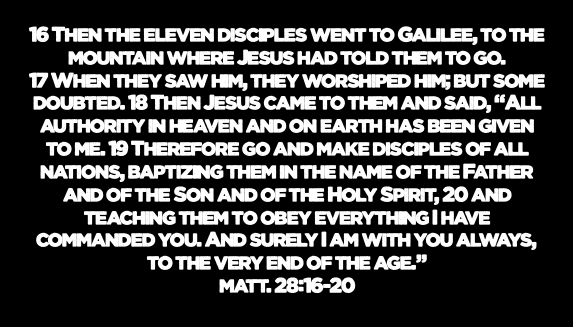
What I’d like to do is to lay out a few of the places where we see doubt play a part in the Gospel story. And believe me, it definitely does. Let me take you first to the Mount of Olives where Jesus met with his disciples for the very last time before ascending into the clouds.

Read that again. Notice verse 17. We’re told, “They worshiped Him; but some doubted.” Hold up. This is the now risen Jesus. This is the man they have watched for three years, day in and day out. This is the man who they all saw walk on water. They watched Him raise people from the dead. They carried the baskets of leftovers from the miraculous feeding of the 5,000 men (and then another 4,000 soon after). This is the man they heard night and day teaching with “power and authority”. This is their Rabbi that they heard predict His own death on a cross, watched (and ran away from) His arrest, and saw Him being nailed to a Roman cross of crucifixion. This is the man they’ve spend forty or so days with post-resurrection. What do you mean “but some doubted”?!?

But that’s not even the most interesting part. What is astounding to me is that Jesus went full speed ahead on commissioning this group of disciples to carry out what we now refer to as “The Great Commission” found in Matt. 28:19-20. What I’m pointing out is that Jesus handed over the carrying on of His Kingdom on earth to a mixed-bag group of believers AND doubters. He could have (and maybe should have) said, “I’m not going anywhere until you can all prove to me that this Gospel is deeply rooted in your heart; that there’s not one shred of doubt within any of you, because the mission–MY MISSION–is far too important to just leave to a bunch of people who are still wondering if I’m the Son of God or not.”

So if you’re struggling with doubt, or ever have, you’re in the best company. The very disciples who Jesus spoke with face-to-face also wrestled with their own doubts. And yet, here we are. Anyone who claims to follow Jesus today can trace their spiritual lineage to one of those disciples on that mountain, staring up into the clouds while the man some of them doubted was God literally ascended into the sky.

Let’s look at another example of doubt in the Gospels and what we can learn…

I won’t launch into a deep-dive exegesis of this passage as I have done in the past. I’ll just point you to this particular verse that comes at the end of the account where we’re told about Jesus’ very first public miracle–one that he was actually completely reluctant to perform. But alas, Mary gave us the very first historical record we have of a Mom pulling the “Mom Card”. We find verse 11 at the tail end of this passage about this wedding in Cana. Notice what it says: “And his disciples believed in Him.”

What were they doing before the water-to-wine miracle? Can we rightly infer that there was less than “belief” in Jesus before that first miracle? It seems they were still kind of “kicking the tires” of this alleged Messiah before that point. Seems like perhaps some of them were not completely sold out in terms of their faith in Jesus.

Okay, one more…

I think Thomas gets way too much heat for this statement. Let’s be real. Dude was only saying what everyone else was thinking. You probably have a friend like that. And what you like about that friend is that you never have to guess where they stand on stuff. Thomas was adamant about his faith. He wasn’t just gonna roll over and put faith where facts go. Nah man, nah. Not Thomas.

But look at where “Doubting Thomas” ended up. Some 3,000 miles away from that mountain where Jesus left him, we find Thomas carrying the Gospel message to the people of India and Turkey, and eventually we find Thomas meeting the end of a spear as a martyr for the Gospel message and the very Jesus that he insisted on seeing for himself. Thomas grew into full faith because he was willing to be real about his doubts.

So even if you’ve got doubt in your story, you’ve got usefulness in God’s story.

Doubts play a redemptive role in our faith. Doubts give us the opportunity to have our convictions tested and proven. Doubts indicate places where we can dig in, ask questions, and find that Jesus really is who He said He was all along. Don’t downplay doubts. Doubts aren’t the enemy of faith, but they can be the paralyzer of growth if left unexplored. Let your doubts show you where to dig next.