Over the years, I’ve had many people ask me about my “call” to ministry. While I do muster up an answer, I have–on occasion–responded with something like, “I’m still figuring that out.” and even “I’m not entirely sure I am called to ministry.”
Such responses are pretty surprising, especially given the fact that, at last count I’ve logged over 3 decades of life to full-time pastoral ministry. And I freely admit that hearing that your pastor wonders about their own call to ministry might be…well… jarring for some. But don’t fret. I’m 100% sure of what I’m 100% unsure of.
What first must be reconciled and embraced in your mind is that (at least to my knowledge) not one pastor has ever stepped into ministry with full confidence in what they’re doing. No one discerns their call to ministry and automatically has a sense of “I feel so prepared. I’m gonna absolutely crush every situation that comes my way. Man, do I feel fully equipped!”
Nope. It’s probably much more like that sense you have when you’re strapped into that new roller coaster you’ve never ridden before. The harness is in place, the coaster starts rolling forward, and you’re hoping for the best. Quick breathing, heart pounding, white knuckles, and uncertainty that you should’ve gotten on at all. Every day.
Did someone say roller coasters? Let me take a side trail for a second here and tell you that I love riding the “Pantheon” roller coaster at Busch Gardens in Williamsburg, VA. It’s one of my all-time favorites.
The first time I rode Pantheon, I had no idea what to expect. I thought it broke mid-ride (if you know, you know). It was a gut-twisting thrill from start to finish. It does things other coasters only dream of doing. And every time I visit Busch Gardens, it’s my first stop. Am I now very familiar with each twist and turn? Yes. Do I still love the thrill and the heart-pounding adrenaline I get from riding it (I don’t know how many times)? Absolutely.
So after 30+ years of ministry, I might wake with a sense of familiarity, but I also wake with a sense of anticipation and excitement over the twists and turns of conversation, interactions, and yes even surprises that come my way.
Later this week, I’m going to meet with a young man who is just now beginning to wrestle with his own sense of calling to pastoral ministry, just shy of being twenty years old. I know our stories are different, but I can’t help but look at this as an opportunity to climb into a time machine and talk to a much younger me, sharing what I’ve learned, what I wish I knew, and how to best leverage the experiences that God is laying in front of me.
So that we don’t simply sit and stare at each other, or worse yet, that I subject him to my endless droning on and on of story after story from my long history of experiences, I’ve created a plan to walk him through what I believe are key truths for anyone discerning a call to ministry.
But to remain true to the title of today’s blog entry, we have to first understand what IS a call to ministry?
I should confess to you that I think we (as Christians, as the church, and/or as pastors) have done a disservice to the idea of calling, and we’ve done that primarily by overuse of the word, or by using it without a certain clarity of what we mean by it. That has resulted in the concept of “calling” or “being called” to mean either anything or nothing at all.
I’m of the opinion that someone who loves the Lord Jesus can be led by Him into plumbing, or teaching, or woodcraft just as readily and rightly as into pastoral ministry. I’m of the opinion that we have inadvertently mystified “calling” to the point where it often feels like a haves-and-have-nots scenario.
I think in simplest terms a calling can be defined as an undeniable compulsion. It’s something that has GOT to be done. It is a fire that is driving us. It can take many complexions, but it most often boils down to this: “If I don’t do this, I’ll always know that I’m not doing something I should be doing.”
I also believe that you can embrace any vocation, job, or career as a type of calling, even if for a season. It might not be what you always dreamed of, but you can still worship God by giving your best to make the most of every day. In that sense, you can view any job as a form of ministry and worship.
So how do you differentiate between a calling and a job? I believe that can be answered by what you view as your desired outcome. Do you desire to leverage your daily activities to point people to or draw people closer to Jesus? Do you desire your daily activities to be a reflection of God’s eternal Kingdom? Do you desire your daily activities to leave a mark on the world that, when observed, leads people to the conclusion that you are a child of God?
If yes, that’s a calling. If not, that’s a job. Both are good, beautiful, needed, and should not be construed as greater than or less than.
In reality, all are called. Every human is called into a relationship with Jesus as their personal Lord and Savior. Every other detail of life is–quite honestly–incidental to that question. So if you’re in a relationship with Jesus and you view your dig-ditching job as just a job, then rest assured that you have settled the most important question of calling. Same as if you’re a CEO, an accountant, or a chef. You’re called. You’ve answered. It’s settled.
Likewise, pastors and those in full-time ministry can erroneously consider their calling as something higher or greater. Nonsense.
No matter who you are, what you do, or any detail of your life– you can step into and live out God’s calling. You can leverage your time to draw closer to Him as your King, and in doing so pass along to others an invitation to do the same. That can be from behind a pulpit or hanging off the back of a trash truck.
There’s probably a couple more volumes of content swirling in my mind on this subject. But feel free to share with me your thoughts and opinions on this topic, even if (and especially if) they are in contrast to what I’ve shared here.
Earlier this year, I was invited to preach at a church in Rapid City, South Dakota. If you’re familiar with that neck of the woods, you know that’s the neighborhood of Mount Rushmore. So as soon as I was done preaching, I took the half-hour drive and went to see this world-renowned chunk of rock. To my shock, I felt like I was the only one there besides a park ranger. I snapped a couple photos (it was golden hour, which was a bonus), appreciated the moment, and got in my car with “Visit Mount Rushmore” checked off the list.
I’ve been thinking about that visit lately. Not because of the faces so impressively carved into the mountain (no offense, presidents), but because of the faces that are carved into MY personal Mount Rushmore. The people who have impacted my life the most. I could tell you their names, but they wouldn’t mean much to you. These are the people that have–as I look back over my life–left the deepest, most profound marks on who I am today.
You’ve got your own Mount Rushmore. We all do. We’ve all got people in our lives who we’d credit with shaping us in all the different ways they have.
Last week a former student of mine from my youth group in NY who is now a pastor himself called me out of the blue to thank me for the investment I made in his life, and therefore in his current ministry. It was heartfelt, precious, and if I’m honest, timely.
So I want to ask you again: Who’s on YOUR Mount Rushmore? Who has sculpted your faith, your spiritual health, and your walk with Jesus more than others have? Name them. Then do what my student/friend/pastor did, and call them. Tell them about the difference they’ve made. Speak from the heart and let them know. If they’ve already been called home to be with Jesus, then write it down.
No matter how you do it, reach out and express your heart to the people who’ve cared enough about you and Jesus to share His love with you.
You know what’s funny? I remember when the “classic rock” radio station played music from the 60’s and 70’s. Joplin and Zeppelin.
This morning I’m driving along, minding my own business, and the universe says, “You know what, Jerry? I don’t think you understand where you’re at in life.” And turning to the classic rock station, I hear the sounds of Metallica and Guns N’ Roses. It’s crazy. You turn your head for a split second and suddenly, the soundtrack of your middle and high school days is “classic rock.” Today, classic rock is hair bands from the 80s.
Watch out, 90s kids. It’s coming for you. Don’t blink. You’ll turn on that classic rock station and “Informer” by Snow will be attacking your aging senses. You’ve been warned.
So there I was, listening to Axl Rose belt out the lyrics first made popular by Bob Dylan in the birth year of Yours Truly…
“It’s getting dark, too dark to see….Feel like I’m knocking on Heaven’s door.”
As I enjoyed the universally poignant sentiments the lyrics convey, I was reminded of something quite powerful. Reminiscent of something I shared with a large group of people last Sunday.
Life gets good–really good–when you embrace its brevity. Nothing else can really do for your perspective what imagining your lifetime ending will do. The mistake we often make (even inadvertently) is that we forget the finiteness of this life. But its finiteness is where we find its potency.
And I know some of you Gen Alpha or maybe even Millennials will dismiss this and file it under “Old Man Talking”, and “That’s fair.” as the kids say today. But some of you are going to lean in closer to hear what this Old Man is getting at. And that’s the great thing about rocking chairs. Their ability to lean in well.
Playing further on the fact that I’m a proud card-carrying member of Gen X, some of my fellow Gen X will fondly remember the show “Double Dare” where kids and families worked together to compete not only in trivia questions, but ultimately one of the teams would win the opportunity to run the famous Double Dare Obstacle Course. And with the timer set, they had to work together to accomplish all the physically challenging obstacles in the allotted time.
If you’ll forgive the rough parallel, every one of us is living under that same time clock. Every moment ticking down at the same rate for each of us, until we too are “knockin’ on heaven’s door.” Right now, hanging overhead, unseen yet as real as real gets, is a clock ticking down.
But here’s the thing that I have to say as clearly as I can. The concept of “knocking” is only found in the bible in one direction, and it’s not us doing the knocking on heaven’s door. In fact, it’s not even Jesus knocking on the door of the heart of the non-believer, as we so famously often portray Him.
The knocking Jesus is doing in the book of Revelation is actually on the hearts of the Church, those who claim to love Him.
This knocking is also wrapped up in the well-known phrasing that “you are neither hot nor cold…but lukewarm.” (Rev. 3:15)
So what if we were to not merely consider ourselves and our lives as fleeting and therefore highly potent, but what if we were to also recognize that Jesus Himself is urging within us a fiery fervor for the things of His eternal Kingdom rather than the things of this temporary world? That’s what the knocking found in Scripture is all about: that the Church be the Church, the Bride of Christ, living out the directives of our Bridegroom.
If you consider yourself part of Jesus’ Church, the Bridegroom, truly one of His disciples (that you claim Him as Savior and Lord, that you have surrendered all of yourself to Him fully, that you obey Him daily, taking up your own cross of idenfication with Him, and that you are a faithful witness to His grace and holiness), then you have to take seriously this knocking. It’s for you.
Rest assured, there willbe a proverbial “knocking” of some on heaven’s door, in a metaphorical sense. Jesus spoke of these kinds of people when He said to His listeners in Matt. 7:21-23, “Not everyone who says to me, ‘Lord, Lord,’ will enter the kingdom of heaven, but only the one who does the will of my Father who is in heaven. Many will say to me on that day, ‘Lord, Lord, did we not prophesy in your name and in your name drive out demons and in your name perform many miracles?’ Then I will tell them plainly, ‘I never knew you. Away from me, you evildoers!’”
I can’t think of a more frightful verse in all of Scripture. Can you?
There are some today, and many who have already passed on, who lived lives thinking they were “in” because of what they did, never realizing that what you do must always flow from Who you know.
“I never knew you.”
If you know Jesus today–really know Him–you aren’t going to have to knock on heaven’s door. That door has been kicked wide open by the life, death, and resurrection of Jesus, and someday very soon, Jesus Himself will welcome you into your rest, with His arms wide open. No knocking, no pleading, no waiting. Your last exhalation on this earth and in this life will be immediately followed by your first inhale of the divine atmosphere of Jesus’ presence. Think about that.
I don’t want anyone reading these words to find themselves knocking on heaven’s door. Acknowledge, accept. and embrace Jesus as your own Savior (forgiver) and Lord (manager). Do it now. There’s no specific or “magic” formula. Simply offer your heart to Him. Tell Him you know you are in need of forgiveness and that you know He alone has made forgiveness possible, and that you receive His forgiveness and ask that He take the reins of your life and lead you, walk with you, and shape you day by day. I promise you He will, but more than that, HE promises that He will. (Romans 10:13)
If you do that, reach out to me. If you’re uncomfortable posting in the comments, send me an email. You can find my email address on the contact page of this blog.
Okay kids, I’m gonna get back to that classic rock station and see what else God wants to say to me through the music of my youth. Which I swear was just last week.
I’ve always been fascinated by the connection between two things: the will of God and the want of man. For decades now, I’ve witnessed and been involved in this tension that lives between what God has clearly stated that He desires from and for humanity, and what humanity is willing to engage with, participate in, and surrender to.
These two are often not the same thing.
I suppose that’s part of the reason why I’m often so reticent to call something a “revival” when others seem rather quick to sound the alarm of God’s Spirit clearly bringing us revival. It’s glorious, it’s wonderful, it’s magnetic, it’s inspirational, and it’s powerful, but is it revival in the truest sense? I pray it is. I don’t stand opposed to the thought. I’m just careful to watch, pray, and fan the ember with hopeful anticipation that it becomes a flame.
What’s got me thinking these thoughts even more lately is an idea that God had laid on my heart, and the heart of several others, to see a deep unity among followers of Jesus in our area.
Side note: In our county as of this writing, there are 234 churches, with about 170 of them being evangelical. Believe it or not, there are 17 churches on the same street our church is on, with only 2 of them with beliefs that would not align with orthodox Christianity. That’s a lot of people in our county gathered under the name of Christ. But what I see and grieve is not nearly enough unity among these churches. Yes, I know about denominational distinctives. Yes, I know about doctrine/theology differences. Yes, I know about church structures, philosophies, and well…preferences and how all those play into the understandable reasons why we have so many churches. Yes, I also know that multiplication is baked into the Great Commission, so I should be celebrating that 234 churches exist in my immediate area. I get all that.
But what I don’t understand is how any local church could choose to turn away from the unity that Jesus Himself prayed for on behalf of His followers. In His well-known prayer for His disciples, Jesus prayed to His Father: “May they be one, just as You and I are one.” (John 17:21) Jesus’ desire for His followers is that we be unified in our love for Him, in our decision to take up our cross to follow Him, in our loving of one another, and in our serving of the lost and least.
As I said, a couple of years ago, we began to talk and dream about a gathering of local churches for the singular purpose of lifting up Jesus in worship, through testimony, and through fellowship. We envisioned a tangible, visible reminder to all involved that the Family of God is far larger than any of us see on a daily basis. We had a vision for new friendships, stronger partnerships, and mutual encouragement among not only followers of Jesus, and soon-to-be followers of Jesus, but also among pastors and ministry leaders. We also have strived to have the venue change for each gathering; we did not want this to be perceived as “belonging” to any one local church.
The result was what we call RVA NOW. That’s shorthand for Richmond, VA Night of Worship. I’d love it if you’d go to Instagram and follow @rvanightofworship. There, you can find photos and video of previous gatherings, as well as stay informed about our next RVA NOW.
At our most recent RVA NOW, we counted over 300 young people gathered together for the sake of spiritual community and unity. We honestly welcome all ages, and you too are free to join in. We have simply chosen to go after the attention and energy of the young generation. We desire God to form within them a heart for unity among believers before things like routine, tradition, and claiming ground based on personal preferences set in. I should also say that our first RVA NOW (we’ve done 6 to date) had 78 people gathered.
Not only did 300 young people show up, but God kept His promise fully that “when 2 or 3 are gathered in My name, there I am in the midst of them.” (Matt. 18:20). I think you’d be hard-pressed to talk to anyone who’s been to RVA NOW who hasn’t sensed the presence of God to one degree or another. At our most recent RVA NOW, we also had an open baptism invitation for anyone who desired to follow Jesus and take that next step of obedience. And that night, we baptized 10 individuals who stood up to declare Jesus as Lord of their lives. As the one doing the baptizing, my heart got bigger and bigger as more and more young people came forward.
(I’ll add here that I also fully recognize that a gathered people are not necessarily and immediately a unified people. So, I do not contend that unity is ONLY gained by physically gathering. But I do think that it can help us move in the direction of unity like few other things can.)
The music was led humbly and powerfully, the testimonies were upheld boldly and unashamedly, and the gospel was preached clearly. God spoke; people responded. Revival? Maybe.
So, why would I not call this a move of God? Why would I be hesitant to label it revival?
Revival isn’t when we can get 300 (or 30,000) people together in one place. Any number of attractions can do that, and it happens all the time everywhere. Revival isn’t when “worship goes long”. Any number of quality worship leaders can massage a set list to invoke a willingness in the crowd to linger and sing. Revival isn’t when tears flow. Emotionalism and sensationalism–whether intentional or not–are things that can be mistaken for spirituality. Revival isn’t when things get loud and energetic. I love loud music and love getting lost in the sound of hundreds (I’ve experienced 10,000-plus voices lifted together) of people singing at the tops of their lungs. A gifted sound team can create a perfect audio blend that wraps us up in frequencies, even triggering goosebumps through the right sounds.
Revival? Dear God, I hope so. Let it be, and let it be here. Let it be a powerful move of God’s Spirit calling people to repentance, to holiness, to surrender, and to disciple-making. Let it be a fresh wind of passion that ignites God’s people to serve ALL people, regardless of their beliefs, convictions, past, preferences, skin color, neighborhood, or reciprocation. Let it be revival that results in saved souls and sanctified servants. Because I truly believe that THAT’S revival.
It’s a regular occurrence. It seems to happen in close proximity to spiritually dynamic milestones in someone’s life: A question that erupts from under the surface of normalcy, complacency, and routine.
The question is something like: Is there more (or something radically different) that God is calling me to?
While the answer is almost always “Yes”, the resulting changes are where most people get stuck. And when people get stuck and aren’t sure exactly what to do, the normal default setting is to do nothing.
I want to open up this conversation by using the term “call” or “calling,” but I want to put some disclaimers on that.
Those in the flow of church life and spirituality can sometimes over-mystify the concept of calling. Many people think it’s a higher level of living out one’s purpose, and further that some are “called” while others are not. This is not my understanding of calling.
So, as we get into this discerning, know that there is no exemption I have found from what I understand in scripture. Certainly, there are callings placed on certain people for specific tasks, but that does not mean others are less than or uncalled altogether.
So when considering one’s “calling”, what should be remembered, considered, and what should weigh in most heavily? These are not questions only for pastors, ministry leaders, or missionaries. These are questions for every person of faith who has decided to follow Jesus.
The very fact that Jesus called disciples in the first century (called the first century because of His birth, and therefore preeminent in centrality in terms of His place in history) should indicate to us that faith in Jesus always includes following Jesus. You cannot have one without the other. Simply put: If you say you have faith in Jesus, you better be in motion following Jesus.
Go back to the gospels and Jesus calling His first disciples (student followers). The plain invitation was “Follow Me.” Not “Believe me”, or “Agree with my claims”, or “Watch me save the world”, or “Stand there and I’ll change you”, but “Follow Me.” That is connotative of placing yourself behind Jesus and, by nature, leaving where you are to move in the direction that Jesus is moving.
Okay, having that well established, how do we discern the direction that Jesus is moving us in? Or more to the point: In what direction is Jesus moving in YOUR life? Is there a way to detangle experiences, emotions, passions, logic, giftedness, opportunity, and desires so that we can see clearly what God would have us do right now at this point in the story? I say yes.
I’ll throw in right here the statement I have made to countless (mostly young) people over my 32 years of pastoral ministry: God will show you what you need to know, but only when you need to know it. I believe this is His way of fortifying your faith-filled intimacy with Him. He wants you close, and giving you the journey one step at a time will ensure your reliance on His ever-present help. So the question isn’t “What should I do in this situation?” as much as it is “What single step should I take NEXT on this journey?”
Don’t confuse Jesus’ invitation to “Follow Me” with “Know everything before moving an inch.”
Discerning the call of God regarding your step-by-step journey is meant to be exhilarating, not exhausting. The very fact that you care to ask discerning questions is an indication of God’s Spirit working in your life. So, take that as a victory regardless of the outcome.
Questions to ask in discerning calling:
What are the things that God is passionate about? What are the things that I am passionate about? Where do those intersect?
What giftedness can I identify in my life, and do I confess that they have been given to me by God?
What are (and where are) the most obvious opportunities right now to leverage my passions and giftedness for Kingdom work?
What step might be a next step to move in that direction?
While I might be content with where I am now, have I become complacent about where I am now?
What open doors are in front of me? How might those open doors be verified as God’s leading? Is it possible that this “good” thing might not qualify as a “God” thing?
Addressing these questions can help to start to crystallize some sense of discernment of God’s leading. But there’s an important aspect of God’s character that should be highlighted at this point. If you feel/think differently than I do about this, I’d love to hear that.
I believe you can be squarely within God’s will whether you are pastoring a local church or stocking shelves at the local Home Depot. I believe God can use a surrendered life as easily in the public school classroom as well as the corporate boardroom. I believe the life of a missionary is no more useful than the life of a plumber in the hands of God.
In other words, there is no scale in terms of God’s will. You’re either surrendered to it and actively following Him, or you aren’t. The details like location and vocation are incidental and secondary to that surrendered condition.
Now, if I have seen verification that I am gifted by God in some area (for me, it is preaching/teaching, writing, and encouraging discipleship among those who follow Jesus primarily in the context of the local church), and yet I am not seeking the place of greatest usefulness according to those gifts, then I do think changes need to be made.
As this is an ongoing batting around of thoughts in my mind and heart, I’ll stop here. I’d welcome any/all of your thoughts about how you define “calling” and what you think are good, helpful questions to ask when seeking to discern God’s calling on your life.
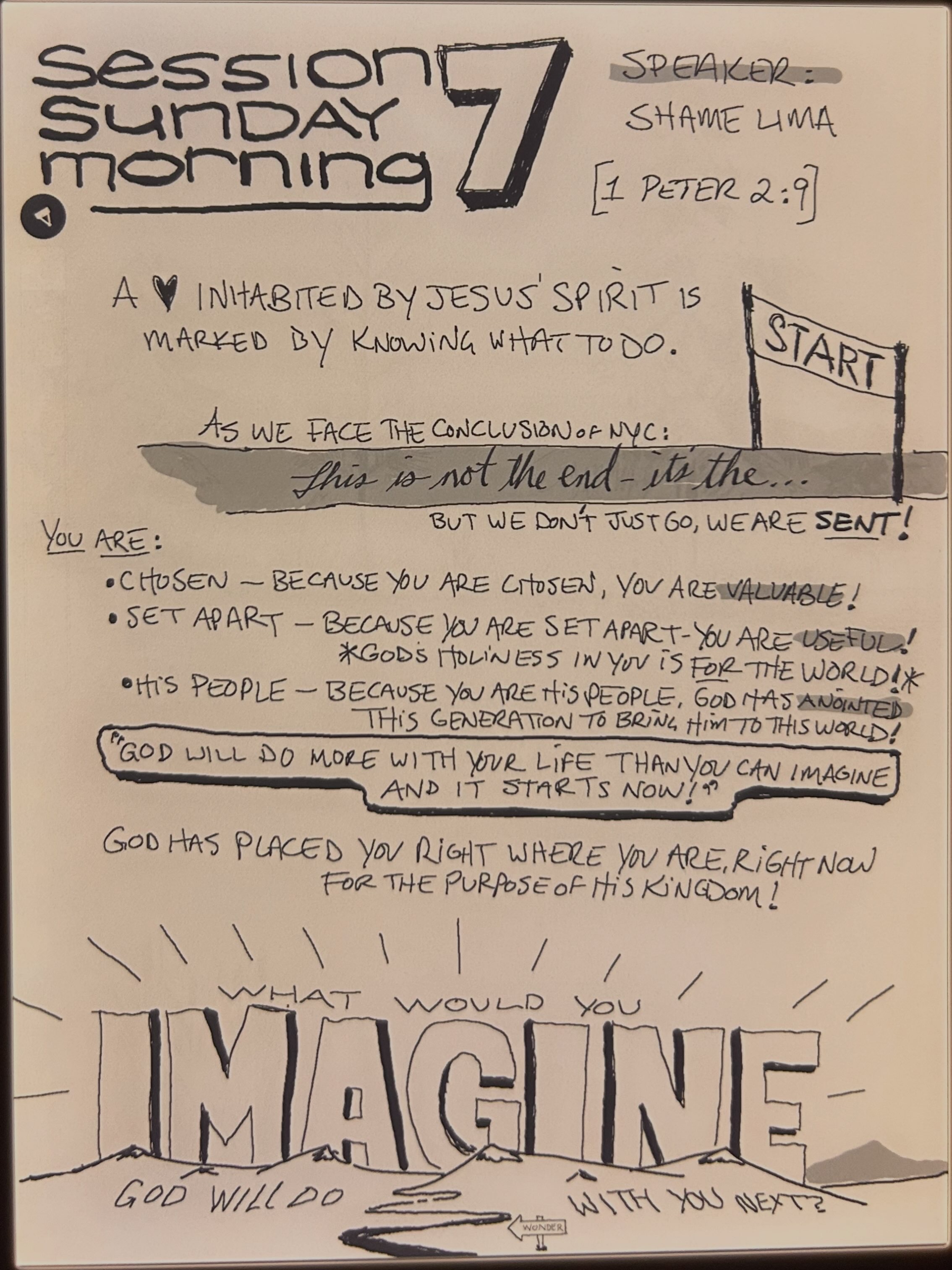
I just returned from NYC (No, not New York City as many assume) which is short for Nazarene Youth Conference. It’s a gathering of young people from all over the United States and Canada, as well as missionary kids (MK’s) from different parts of the world. It happens roughly every 3-4 years. This year’s NYC was the largest in its history, dating back to the first gathering of Nazarene Young People in Estes Park, Colorado is 1958. That year, there were 763 people in attendance.
1958: 763.
2026: 10,000.
Think about that.
This year’s NYC was held in Salt Lake City, Utah. I’ve been attending NYC’s since 2007 and while each one has it’s own distinct flavor, I have to say that this one in particular ranks differently than any other NYC I’ve been a part of. Keep reading, and you’ll soon understand why that is. I might even go further to say that this has been my favorite NYC I’ve ever been a part of. Again, you’ll understand why momentarily.
Let me disclose some things first and make a disclaimer as well.
First, full disclosure: I’ve been more involved in the “behind the scenes” stuff of this year’s NYC more than any other I’ve attended in the past. So, I’m coming at this recap from a very different place. I got to see almost all of the parts of NYC that the average participant doesn’t get to see. So you should understand that I’m coming from a unique perspective. I’ll get into all the ways I’ve been involved as we go along.
Next, the disclaimer: I’m going to share some things that might…just might…sound at first blush as a critique of church culture. I absolutely do not intend to communicate anything that is anywhere near negative. I find that it is through exceptional experiences like NYC that we get to recalibrate our vision, our methods, and our goals in terms of making (young) disciples. So as you read, understand that my mind is prone to rabbit trails that wander off in directions simply triggered by an initial experience.
Okay, let’s get into this recap. I’ll do my best to take you along the timeline, but don’t hold me to that.
I arrived in Salt Lake City on Monday, June 29 2026, and got checked into my hotel. I stayed at The Peery Hotel in downtown Salt Lake City, just 2 blocks from the “Salt Palace”where the NYC event was being held. The Peery is not your typical hotel; it’s a renovated old building that has a distinct charm often lacking in more modern hotels. Creaky floors and all, I really did enjoy my stay at The Peery Hotel. I only had breakfast there once, and had the avocado toast at their in-house restaurant called “Eggsburgh.” I highly recommend it.
Then on Tuesday, I got to meet the team I’d be working with for the week. I had been asked several month prior to NYC if I’d consider being a part of the social media team that served as “hosts” for the event via social media platforms Instagram and Facebook. I had never met any of the team prior to the actual event except for a Zoom call or two to go over our plans. I couldn’t have known just how powerful a role each of them would play in the week that was ahead of me.
Believe it or not, part of my role was to be creating and posting videos and content that engaged primarily students and leaders in attendance at NYC, but it also was free for anyone following the account nazarene_youth_conference on the two platforms we were posting on. So family and friends from all over the world could play along with us as we went about our week.
*You can, at any time, go back and watch the sessions here. What a gift! What a time to be alive where we can essentially hop into a Time Machine and be taken back to some powerful, poignant moments in worship and the Word!*
Let me try to explain something.
Every person who participated in NYC 2026 has now experienced what it feels like to be surrounded by 10,000 teenagers collected from all corners of USA and Canada for the purpose of centered our attention on Jesus. If you were to ask of them what it was like, you’d get a myriad of responses, yet the common thread you’d hear is that you really can’t describe it; you’ve got to be there.
Let me try and help by sharing with you a recap video…keep in mind that this is just day ONE!
Throughout the week, we experienced powerful messages from talented speakers, and incredible, world-renowned musical talents such as Hulvey, Josiah Queen, and Elevation Rhythm. I can’t even express how powerful the ministry was from each of these. They were anointed for that moment, and each of them stepped beautifully into that role. God used each of them, though they were entirely distinct in their vibe, their style, and their approach. It was in itself a beautiful snapshot of the Kingdom of God.
Let me pause here and ask that you consider who you are; who God made you to be.
We live in a world saturated in comparative living. We are constantly pulled into a mindset that sets us as either deciding we are better than or less than. But would a red thread in a tapestry have anything to critique about a yellow thread they were next to in that incredible work of art? God has ordained your life to impact the world around you in the way He has created you. Submit your thread to the beautiful work of art God is stitching together, and have no thought about better thans or less thans. You, sweet child, are precisely the person that God created, adores, and wants to use for His glory and your own good as you submit everything you have and everything you are to Him and His care.
While I was a part of each of the 7 “main sessions” where we all gathered together, I was also partnered with a new wonderful friend named Bailey Friberg as we hosted via social media. I’ll post a few of our videos below, so you can get a sense of some of the antics I got to be a part of. Scroll down the right side and click on any of the videos to see the progression through our week.
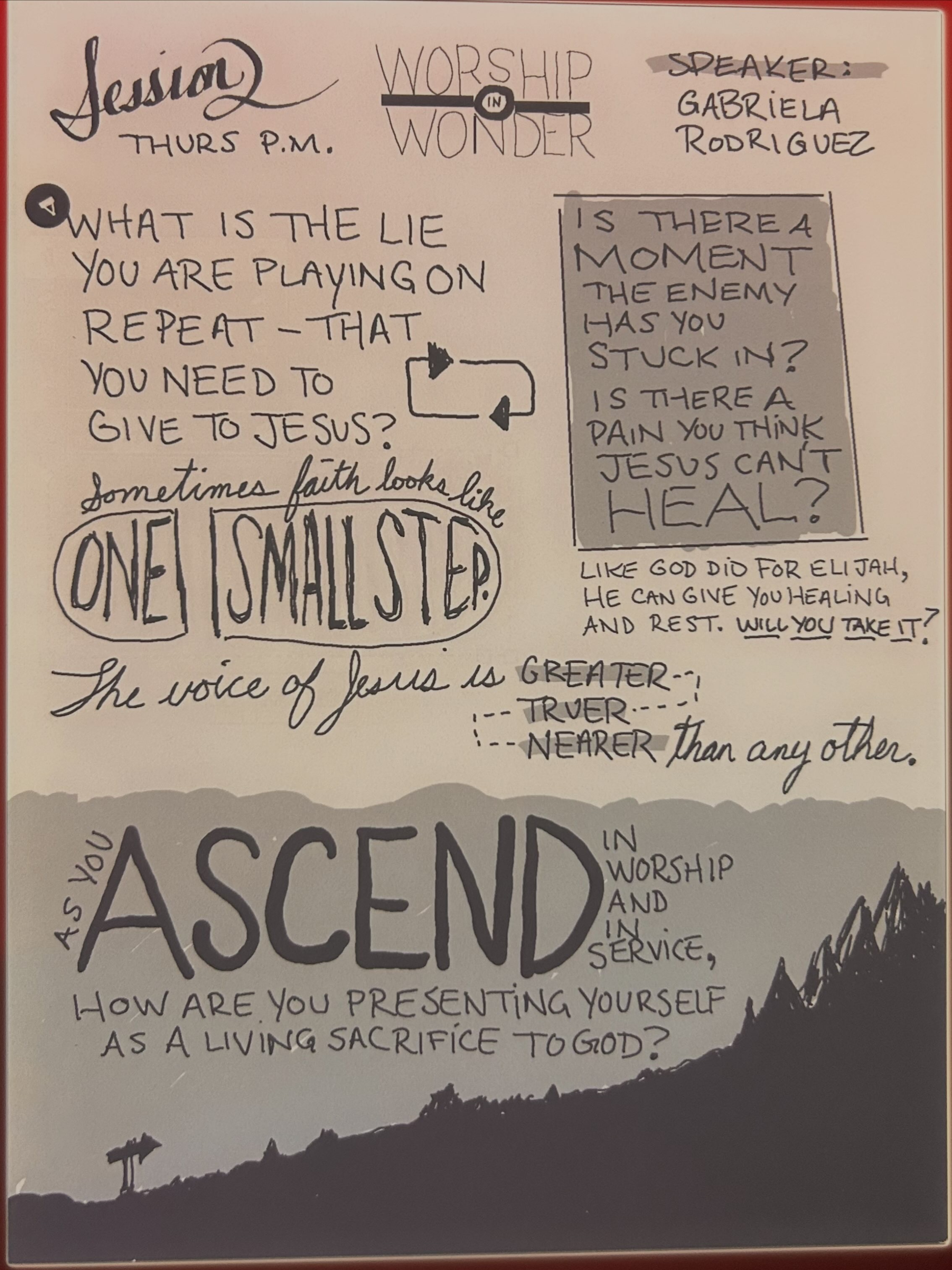
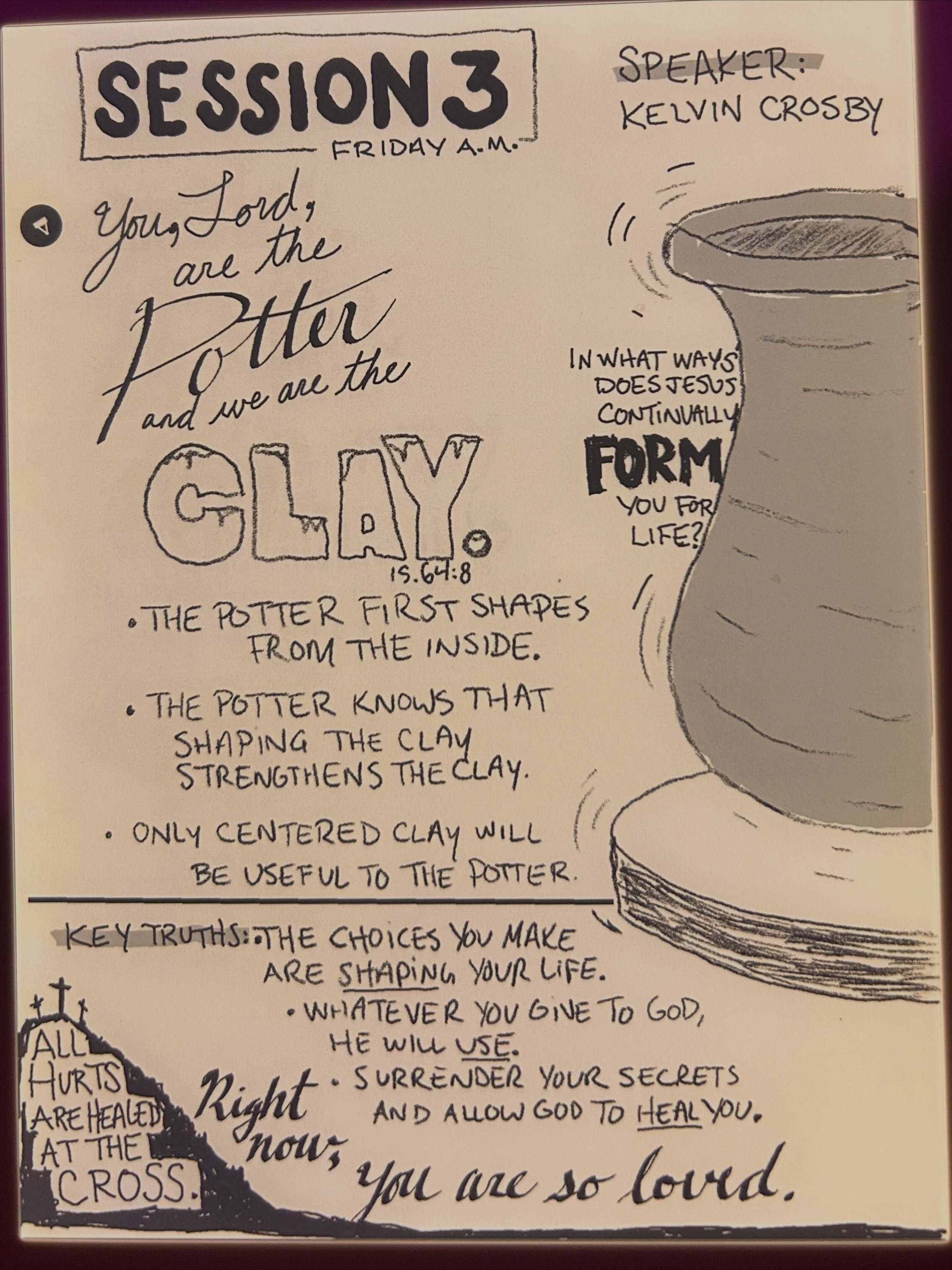
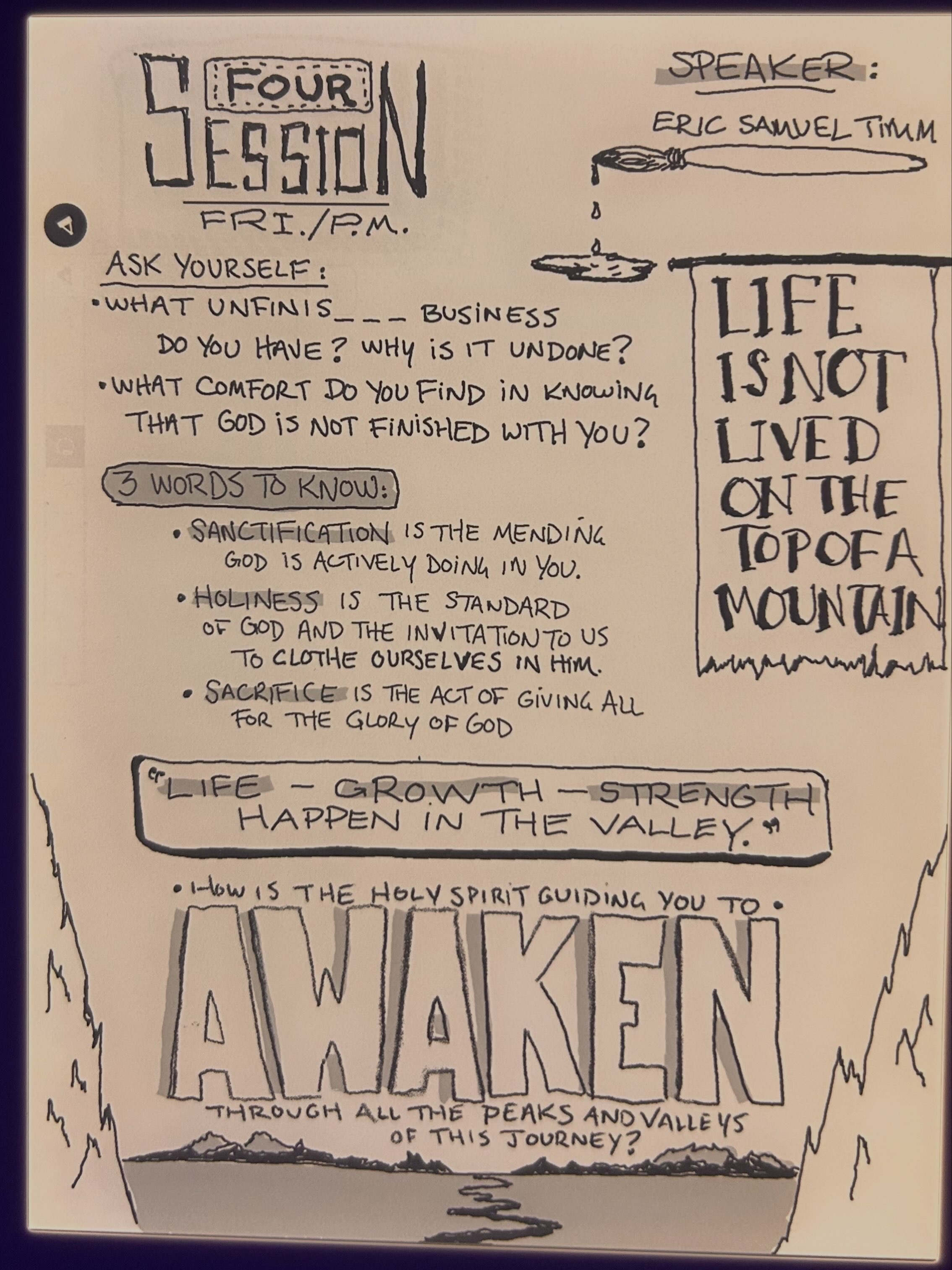
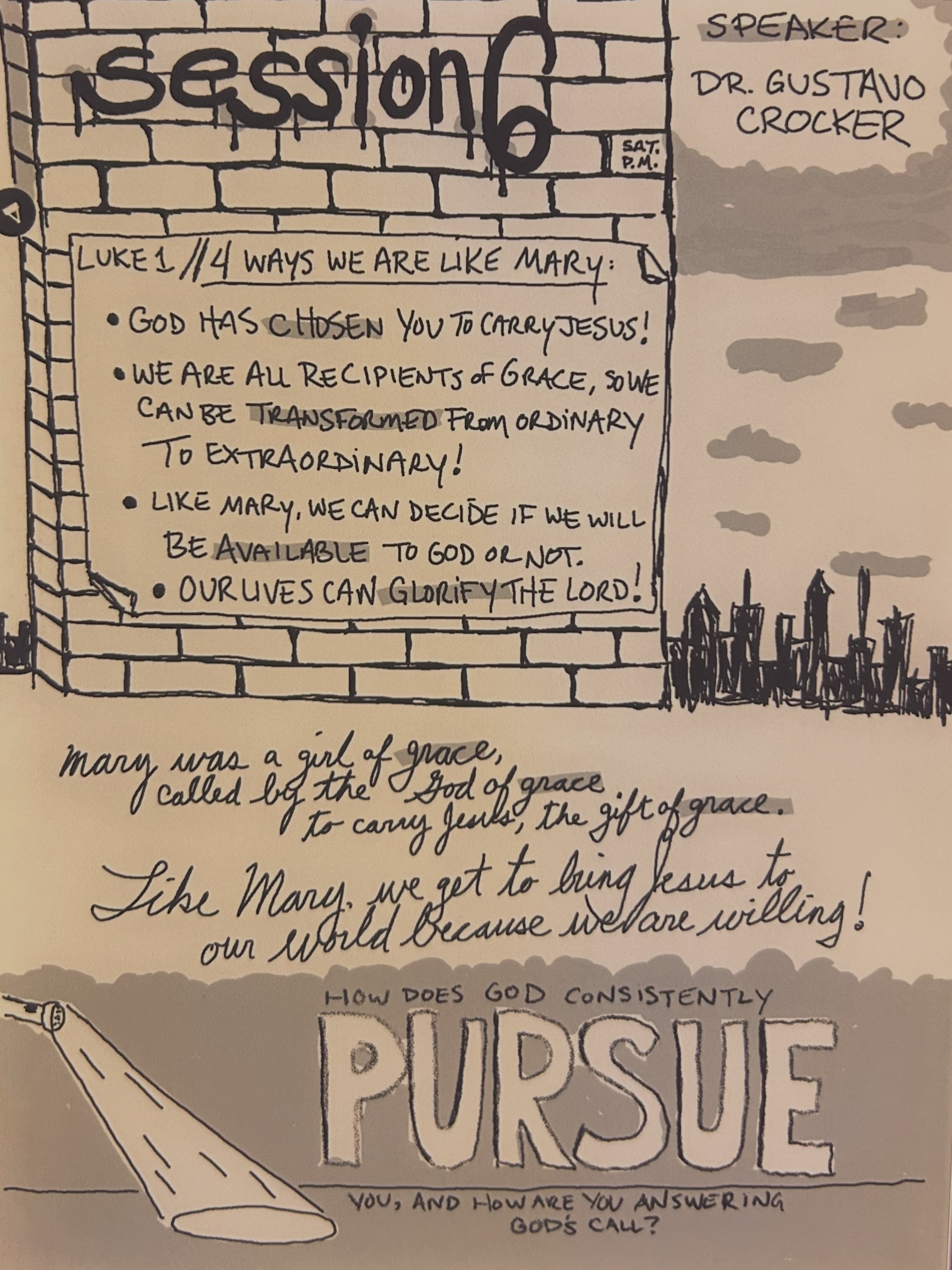
From the platform during each session came incredible truth being preached from talented communicators. As part of the NYC media, I was asked to post/share the notes I took for each of the messages.
For some background, I’m a very visual learner, and when I am listening to a speaker/preacher, I typically turn that information into visuals. I’m no artist; I’m more of a sketcher/doodler. Some time ago, my notes were noticed by Justin Pickard, who leads NYI for USA/Canada, and that’s how I came to be invited to, after each session, post what I personally had written/doodled down in a way to help others remember, process, and digest what they heard.
The theme for this year’s NYC was “WONDER“, and it is something I am very well acquainted with. I was brought in to the planning of NYC early on, and asked if I would co-author the 60-day devotional book that every participant would receive, as well as writing the 6-week small group curriculum groups could choose to go through in preparation for the event in Salt Lake City. It was a honor and true labor of love to complete those projects as well. Here’s a photo of me with co-author, Miranda Musik.
As we went throughout the week together, I couldn’t help but stand in awe of God’s power, His promised presence, and what He is doing in this young generation.
I should say here that from the very beginning of my pastoral ministry (circa 1995), I have never had any aspiration to do anything other than actively invest in young people. So to spend a week in a sea of 10K of them, and to see moments of worship, wrestling, growing, and reveling in God’s promises…well….can you even imagine my elation?
But I also want to share a few unformed thoughts that I’ve been kicking around as I’ve digested this week in Salt Lake City. Be cautious not to hold me too tightly to any of these meanderings; they’re really just forming into things that may or may not gain any traction.
In no particular order:
Spiritual experiences MUST lead to practical expressions.
I’m entirely uninterested in simply creating a hyped-up event for young people that quickly becomes a blurred memory, consisting of little more than some social media posts and vaporous emotion.
If what we experienced isn’t followed by transformation of the mind, heart, and therefore behavior then what have we really done?
Yes, NYC 2026 was absolutely electric in it’s atmosphere, it’s excitement, and it’s energy. But we unashamedly call it a “mountaintop” experience so that life in the valley is transformed.
To identify with the cross of Christ is to connect eternally with the people of Christ.
Something followers of Jesus must be experts in is connecting, community, and fellowship. This is both for the unity Jesus Himself prayed for, AND for the purpose of being our first apologetic. “They’ll know you are my disciples by your love for one another.” (John 13:35)
It is imperative that followers of Jesus understand that if we are adopted (and we are), then by definition we are FAMILY. That’s why I can walk into an arena of 10,000 people and feel a familial sense. Which leads me to…
The purpose of connection is to walk out our fellowship-fueled mission.
I bet you can’t think of or name one person who is flourishing in their following of Jesus apart from real community. The reason that is is because in God’s grace, we are designed to walk together in the mission of the gospel. When we don’t, we can’t.
Of course, we’re empowered by God’s own Holy Spirit, but the pouring out of His Spirit in the book of Acts was on a gathered group of His disciples. They were together in one place, and then together began to proclaim the good news of Jesus in power and in bold, collective witness.
The worship of experience is not the same as worship of Jesusand we need to be careful about that.
Anytime we think about worship, we must be careful to keep Christ central. This seems like something that shouldn’t need to be said. I say it because I believe that in our day of production value and excellence in worship leadership, we can inadvertent celebritize those who only seek to lead others in worship of Christ.
We cannot mistake production for Presence. NYC 2026 was–by necessity–a beautiful orchestration of logistics. As a part of the volunteer team, I got to be in the room for sound checks, rehearsals, and other efforts made to ensure that the worship gatherings went unhindered. Yet none of that good work can replace the Presence of God.
We cannot place our emphasis on the act of worship more than the person we are worshiping. Yet I fear that we are dangerously close at times to doing just that. We get wrapped up in the songs we know, the volume we prefer, and having the song set hit the right stride.
These were not things that were taught from the stage at NYC per se, they were just thoughts that I had that were triggered by my personal NYC experience.
Lastly, I have to talk to you about the team I got to serve with most closely. I was a part of the social media team and I cannot tell you how much I enjoyed every single one of these four new friends I made. Keep in mind that before last Monday we were all virtual strangers. And as I type this just one week and one day later, I would not hesitate to jump head first into any future project with any of these wonderful servants of Christ.
We jokingly compared our new friendship to “camp friends”; people who are strangers at the start of camp but best friends by the end of the week. I’m so grateful for each of them, and God showed me Himself through them as much as He did in any other way throughout the week.
I’ll post a picture of our team together, on our last day before saying our goodbyes. (Photo at bottom of this post.)
In an effort to wrap up this recap, I want to bring us all back to the issue of Wonder. I truly believe that stagnancy in our spiritual lives creeps in when we lose our Wonder of God. When we stop using phrases like, “What would happen if I…”, “I wonder what God is trying to show me and teach me through…”, “What might happen to my spiritual closeness with Jesus if I….”, and “Where is God most clearly moving/leading and how can I be involved in that?”
So what WONDER-filled step will you take right now? There’s no need to wait. Simpy choose to be someone who is filled with wonder and therefore someone who steps boldly into the places where God is inviting us.
I’ve been invited into a conversation with a couple of men considerably younger than I am, and from what has been shared with me (we haven’t met together yet), they’d like to talk about the “minimally viable church”. It seems this is an expression that describes the conversation we’ll have, about what is truly necessary to make church “work”, (and no more) or what are the bare minimum components that need to be present for us to consider a church not merely in existence, but faithfully and functionally fruitful.
(If I’m reading between the lines, perhaps there is a discontentment or even disillusionment on their part with what the modern Church is or how the Church operates at this time in history. If so, they have certainly found a sympathetic ear in me.)
I was instantly intrigued at this invitation. Unbeknownst to the inviter, I had already been allowing my mind to think thoughts right along these lines. Unless he reads this blog post, he still doesn’t know I’m well on my way to being locked and loaded for our conversation over dinner. So I thought it might be good for me to pound out my own thoughts as a primer to this conversation.
I think a fundamental question that must be addressed is the simple, “Why church at all?” Certainly many people who perhaps once held church participation/attendance/activity as important (or even central) in their lives have since moved away from such convictions; some for understandable reasons and maybe even logical reasons, but none for legitimate reasons. And I do mean none.
Here’s my answer to the “Why church?” question.
It starts with the very nature of God. God exists eternally in community with Himself. I’m not going to delve into the doctrine of the trinity here, but I am going to suffice it to say that I believe in the triune God: Father, Son, and Holy Spirit. The doctrine of the trinity is arguably the most perplexing doctrine in all of the Christian faith, but this doesn’t preclude me from embracing it. In fact, it is because of its perplexity that I am drawn to it, and thus drawn to God.
Because God exists in community, and because God in community created us in His image (Read Genesis 1-2), we are hardwired for community. Simply put, we are healthiest when we have connective, redemptive community engrained into our daily lives, regardless of the complexion that community takes. More on that in a bit.
Right in line with understanding the communal nature of God, we must also recognize the literal definition of the term “church”. Many think “church” is a building that is used once, maybe twice a week. We may equate it with a “service” we attend wherein we sit down, stand up, sit down, then stand up at specific times. But these are actually not the church at all.
The word used in scripture for “church” is the Greek word “ἐκκλησία” (ekklesia) and it literally means “gathering” or “assembly” It’s a two part Greek word made up of “out of” and “to call”, so it can be rightly translated as “the called out ones”. No matter which way you slice it, the truth is the church can never just be you or even the popular “I’ve got Jesus, so I don’t need the church.” The Church is literally defined as US; those who are “called out” and “assembled.”
Next, as we look all throughout scripture, we see that God deals both with humans on an individual level AND on a communal level. But notice that God dealing with an individual ALWAYS impacts the community. Look at nearly any example in either the old or new testaments and you’ll see that God speaks and deals with us as a people, even while extending His love and grace to each individual. Again, we see the emphasis placed on community, connectedness, fellowship, and all the other qualities that flow in and through the Church as God desires.
Next, look at the writings of the Apostle Paul all throughout his 13 letters to the churches in the first century. You’ll find a minimum of 18 different and distinct “one another” commands in his writings. I’ll include them below.
Love one another (Rom 12:10; 13:8; Gal 5:13)
Be devoted to one another (Rom 12:10)
Honor one another above yourselves (Rom 12:10)
Live in harmony with one another (Rom 12:16)
Stop passing judgment on one another (Rom 14:13)
Accept one another (Rom 15:7)
Bear with one another (Eph 4:2; Col 3:13)
Forgive one another (Eph 4:32; Col 3:13)
Instruct/admonish one another (Rom 15:14; Col 3:16)
Greet one another (Rom 16:16; 1 Cor 16:20; etc.)
Agree with one another (1 Cor 1:10)
Serve one another (Gal 5:13)
Carry one another’s burdens (Gal 6:2)
Be kind and compassionate to one another (Eph 4:32)
Speak to one another with psalms, hymns, songs (Eph 5:19)
Submit to one another (Eph 5:21)
Encourage one another (1 Thess 4:18; 5:11)
Build up one another (1 Thess 5:11)
If we should not care for other believers, or gather to encourage them, or live in spiritual community with them, what would be the point of such an extensive list of instructions regarding how to live in community?
Let me bring it down to a more personal level. Let me tell you why I choose to be a part of a family of followers of Jesus. Quite simply, it’s because of the love I have for Jesus Himself that gives me a love for people, and a desire to connect with those who love and follow Jesus, for the purpose of mutual encouragement, edification, fellowship, accountability, and learning from others as I grow in my faith walk with Jesus. These are just a few of the reasons I choose to be a part of a family of followers of Jesus.
As John Ortberg wrote, “To follow Jesus IS to follow Him into community.” There can be no other way. Think of Jesus calling His disciples and the three years He taught them, prayed with them, ate with them, and lived with them. He created community among those men and women.
The Church has certainly evolved over the millennia. Yet there are just four parts in terms of components for “church” that I can see from a biblical standpoint. If you look at the birth of the Church in Acts chapter 2 at and following Pentecost, you’ll see that followers of Jesus devoted themselves to four things: teaching, fellowship, eating, and prayer. And they did this in just two ways: In the temple courts, and in their homes. The “home church” movement eschews the larger gathering (to its detriment), and those who do not gather in homes are also missing a critical aspect of what it means to live in community (to their detriment).
Could it be that what we see in Acts 2 is the recipe for the “minimal viable church”? I understand that culturally speaking, we are far from 1st century Jerusalem, and that life as we now live it seems such a far cry from the simplicity of those days of the early church. But this is why, I think, the question is being asked by these two young men inviting me into a conversation about what–at minimum–is needed to build and enjoy a thriving spiritual community to the glory of God and the building up of His bride, the Church.
As I often do, I’ll stop here, mid-stream and ask: What are your thoughts on this? What if you were being invited to dinner to discuss the “minimally viable church”? What would your input to the conversation look like? Share them in the comments. I’d love to hear them.