Death Becomes Us

I was just driving along with my youngest son down a winding road lined with woods on either side, and said, “I’m so glad we live in a place where we get to see the colors of changing leaves during the fall season.” It’s nature doing what nature does. I really do love the transformation that death brings us. It’s inescapable: death is beautiful. Each leaf you see falling to the ground is a seconds-long funeral service you’re witnessing as it passes from one reality to another.
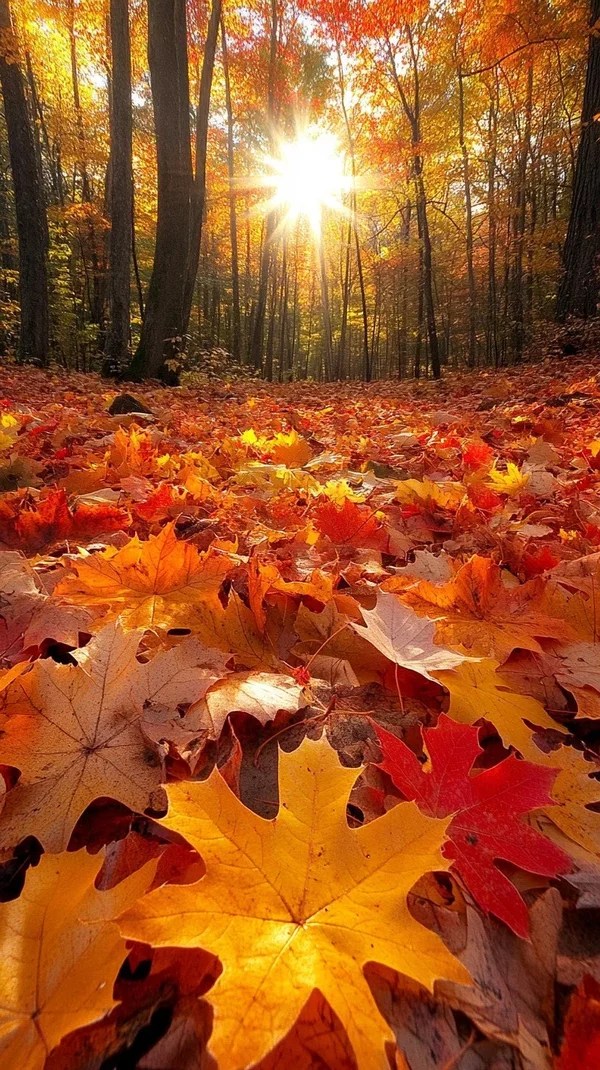
The varied and vibrant colors of the leaves are brought about by the decrease and eventual shut-off of chlorophyll, the thing that makes leaves green through photosynthesis (the feeding process of trees and plants). As temperatures drop, the tree is actually cutting off water and nutrients to its leaves in preparation for going into the non-food-producing season. That’s when the other chemicals present in the leaf, like carotenoids, anthocyanins, and tannins, get to show their colors–the yellows, the shades of orange, the purples, the reds, and all the variations of those colors, albeit for a brief but brilliant display.

At the base of each leaf, the tree actually seals itself shut, and the leaf eventually browns, oranges, purples, and yellows…and falls away. That’s when we get to see the cascading leaves making their final journey to the ground below.

It’s all breathtakingly beautiful. As we revel in it with our pumpkin spiced whatevers, and our chunky sweaters, and our wool socks, and our folksy acoustic music playlists that create just the right vibe, it’s actually death that we’re revelling in.

I was reading in the scriptures this morning, and I was reminded of the beauty of death in Paul’s words to the church in Galatia in the first century: “I have been crucified with Christ and I no longer live, but Christ lives in me. The life I now live in the body, I live by faith in the Son of God, who loved me and gave himself for me.” (Gal. 2:20)

In other words, Paul has declared his own death. His own cutting off of that system that would feed his flesh and usher in the transformation into beautiful and vibrant color for the remainder of this brief period of time called life. In a very real sense, as we watch those leaves falling around us, we are watching a wonderful symbolism of a life born into Christ, the accompanying death to self that must happen, and the transformation from death to glory that losing ourselves in Christ brings about.

May we join those leaves in their vibrant death. May we consider ourselves as dead to ourselves and alive only to Christ, finding our beauty, purpose, and life in Christ alone. May our lives be a brilliant display of grace as we make the slow, wind-swept journey homeward.

On Handling Turtles

I was just a couple of minutes from my home; on my way to the airport. I came to a curve in the road, and noticed that there was a vehicle pulled over to the left-hand shoulder with their hazards on.

Pause. Let’s talk about the “fight or flight” response that each of us has hard-wired into us. When presented with an unexpected situation/crisis, there are those whose instinctive response is “flight”, meaning they want to get away from that situation as quickly and safely as possible.

I’m not a flight guy.

Anytime I see something out of the ordinary, or anything that might be a situation where help might be offered, my instinct is to offer it. But it took me about two nanoseconds to realize there wasn’t a crisis–well, not a crisis I could help with. Unpause.

A woman bounded out of that car that had pulled off on that left-hand shoulder, and a second later, I could see why: There was a turtle in the middle of the road. She saw it and apparently was intent and determined to intervene. I drove safely past, but watched the situation unfold in the seconds following, in my rearview mirror.

I’ve heard a few different theories/cautions when it comes to “helping” turtles across the street. Some say it’s best simply to leave them alone to let them roll the dice on their chances of getting across the road with shell and life intact. Some think they should pick them up and bring them to the nearest safe ground, even if that’s back where they came from. Can you imagine being a turtle and the speed at which they travel, and having a giant pick you up and put you down at what equates to miles back the way you just walked??? If turtles could curse, am I right?

This woman chose to speed the turtle along on their journey in the direction they were headed. If turtles could bless, am I right? As so often happens, I immediately had a sense that this very quick rescue mission had something to do with how people of faith in Christ live. Maybe a lot to do with it. Maybe not.

Probably not. But I thought it anyway. And true to the spirit of this website’s title, here I am.

I’m not a turtologist, but I do know there are different types of turtles. And as such, there are a variety of turtle temperaments. What, you think “snapping turtles” got that name from the way they snap in the jazz clubs after an especially smooth number wraps up? I’m fairly certain it’s more nefarious than that.

So back to the lady and the turtle. She saw a need. She saw something in danger. She saw that she could do something about the situation. She sprung into action, with little regard for her own welfare (remember that curve in the road I was coming around when I came upon her and her rescue mission).

She was determined–come what may–to do something about the destination (and destiny) of that shelled friend. Bottom line: she cared enough to act.

That’s one half of the story. The woman. But what about the turtle? Let’s imagine the turtle could decide how they would respond to the attempt of the woman to “help.”

Do we care enough to act? I think most of us would say that we do. We see needs, we even see peril, and we step in to serve, to respond, to help, to save the situation. It’s actually the most Jesus-y response. Read the gospels. Seeing humanity in need and choosing to simply drive by was not an option for the Messiah. Indeed, “to seek and to save” was His mission. It’s stated clearly in Luke’s gospel. (Luke 19:10)

But what of the turtle’s response? Can you imagine that turtle stretching out its neck so it could reach back to the hand that had reached out to help it, and sinking its beak into the flesh of that hand? Can you imagine that turtle withdrawing into the safety of its shell when a do-gooder approaches? Can you imagine that turtle yelling back over its shell (do they have shoulders?), “Maybe your truth is that I should get safely to the other side, but that’s not my truth. Now put me down before I pee on you! I’ll take my chances with traffic, you intolerant bigot!”

I realize that likening the Christ-centered life to a turtle crossing might push you to unsubscribe from my little blog website here, and I guess I have to own that. But since most of you aren’t subscribed anyway, I’m just gonna take my chances. (That was my not-too-subtle way of inviting you to subscribe.)

Back to my question: Do we even care enough to do something outside of our predetermined path? Are we willing to do what(ever) it takes to intersect with the lives of others, as they hurdle toward danger, and offer them another alternative?

A great man and friend, Jerome Hancock used to tell us (in the context of our local church’s ministry): “Those around us might be on their way to hell, but they’re going to have to go through us to get there!” There’s this defiant determination that the turtle-loving woman I saw put on full display. No matter what it costs, I’m going to do something when I see someone hurdling toward an eternity apart from God.

I know, I know. Some turtles not only don’t want help or saving–they don’t even think they’re in danger. So we handle that as it comes. But that must never stop us from living in such a way that we at least offer those around us an alternative to going it alone on their own strength.

“For the Son of Man came to seek and to save the lost.” -Luke 19:10