I was just messaging my Dad, and he was asking what I was doing today. He knows it’s my day off, so on Fridays, it’s anyone’s guess as to what I might find myself doing; at least in the morning before my wife gets off work at noon and all my attention moves to her.
I said, “I’m headed to grab some coffee and do some writing.” I followed that quickly with, “but I’ve currently got too many rabbit trails in my head.”
It’s true. While driving my son to work earlier this morning, I was daydreaming about enjoying some hot coffee at a local coffee shop and opening up my laptop in order to pound out a long-overdue (as if there’s a schedule to this thing. You know better than that) blog post.
But the plight is one you might be well familiar with. It seems that lately every cage in the zoo of my mind has been unlatched, and every thought has been permitted to run rampant. I’m mentally wrestling with a slippery eel in one hand and a wily ostrich neck in the other. Zeroing in on a focused thought seems like organizing meerkats.
So in an effort to bring some semblance of order here, I’d like to–one by one–wrangle up some thoughts, updates, queries, and ideas. You, my reader, are the lucky one who gets to ride shotgun on this safari jeep I’m driving.
I’ll start with the most glorious, wonderful, bliss-filled news of all. On January 20, 2026, my wife and I were catapulted into grandparenthood with the arrival of Bailey, our first grandchild! The long-awaited arrival of this new human did not disappoint–as we got to hold her at just hours old, we began to have a sense of some new kind of love we haven’t had the opportunity to have. It’s a love that amplifies the love we already had for our daughter, because now we share parenthood in common with her, and we also are recipients of a wonderful opportunity to have a place in our granddaughter’s life. It isn’t that we begin parenting again–no, no. We’ve done that. It’s that we are now in an incredible and enviable position of standing by and absorbing the joy of watching our child parent their child.
Next up on our corraling mission is something that might seem a little on the esoteric side. I’ll do my best to broaden this enough for anyone to grab hold of it, but there are pieces of this I’m sharing from a pastoral point of view. File this under “behind the veil”, perhaps. I’m not one to shy away from sharing even thoughts that are unformed or perhaps even eventually embarrassing. It’s the road I’ve chosen when writing on this blog. You’re going to get authenticity, if nothing else.
The best way to share from this pastor’s heart is to share a case study of sorts from my night last night. I was lying in bed enjoying some much-needed sleep when at 3:07 a.m. I woke up. I remember the time distinctly because I grew up at 307 Townbank Road in North Cape May, NJ. I was awake at that point briefly before dozing back to sleep. Then at 4:20 a.m. I woke again; this time for much longer. (No, I do not have the relationship some people do with 4:20.) As I lay there, I was ping-ponged by about 6 or 7 different situations in my life. My mind was thrashing around about a variety of to-dos, what-ifs, and did-I-forget-to’s. In the midst of it all, I entertained thoughts of ministry validation, emotional investments, relational missteps, and a gamut of not-entirely-helpful ponderings. It was bedlam in my brain.
I decided, as I sometimes do, to evolve my worrying and wondering into worshiping. Before you get impressed, let me finish. I turned my attention to Jesus and what I imagine Him to look like. He’s my best friend, my Savior, and my professed Lord. I started in on a chat with Him about how I was feeling, what I’ve been doing (as if He doesn’t know it better than I do), and the thoughts that had occupied my mind and heart. I’ll confess to you that at first I didn’t do too well on the listening part of prayer. I just kind of brain-dumped on Him. Before I even got to the listening part, my brain then wandered off, back into the thoughts that had swirled and bounced around on the inside of my cranium, like the numbered balls in the Powerball lottery machine.
Catching myself, I snapped back to attention on Jesus and had another go at a conversation with Him. “Lord, I love you. Teach me how to love you better. I know I’ve got lots of room to grow in that area…”
Then my mind again trailed off into some concern for the young people I’ve invested in over recent months and years. I often concern myself about their well-being; mentally, emotionally, socially, and mostly spiritually. I began to think about how it seems like other pastors have it together, but I don’t. Like others seem to know what to do and how, and when. I began to fall into the wasteful train of thought that others have what I don’t, and even if I could know what they know, I wouldn’t be able to execute like they do. In a word, it was sheer insecurity. Stupid, wasteful, untrue insecurity. I’m embarrassed that I fell for it.
Do you ever think like that? Another lie (that I know is a lie) is that I’m the only one who thinks like I do. The enemy tries to convince me of that so that I’ll feel disconnected from any sense of commisseration with others. Make no mistake: I know that the enemy’s #1 weapon in any battle is isolation. If he can get me feeling isolated, or lonely, or unrelatable, or exiled in any way then most of the battle is won. Do you ever fall into the trap of thinking that you’re alone in the struggles you have, whether they’re mental, social, emotional, relational, physical, financial, or spiritual?
Then, as I snapped back once again to Jesus’ face, I was instantly reminded of the peace-filled companionship and compassion He has on an ongoing basis for my benefit. No matter how many times my frail mind trails off down whatever rabbit trail, He is patient with me, welcoming me back again and again and again and again. Oh, the depth of love He has for me and for you, despite our distractedness, our flimsy affections, and our propensity for nonsense.
Another rabbit trail was/is our younger daughter, who lives much further away than our oldest daughter (the mom to our new granddaughter). She is pregnant with our second grandchild and our first grandson, due in May! So naturally, I’m often thinking of her, her wonderful firefighter hubby*, and how that little unborn guy is doing. (*Btw, that house on fire over there held our son-in-law as he helped extinguish that raging inferno a couple of days ago.)
I’m envious of families who all live near one another so that grandparents have frequent interaction with grandchildren. I was reading an article recently about the mental and physical health benefits that grandparents enjoy from having interaction with their grandchildren, and even the benefits on a child’s development when their grandparents are in their life. It’s a classic case of a “win-win” situation. I like to daydream about being the kind of grandpa that is always within arm’s reach, always ready to hang out, always ready to grab an ice cream cone, always ready with a listening ear, always ready to buy up the opportunities that I may have missed the first go-around.
Yet another rabbit trail is an upcoming event I’m overseeing at our church. It’s a marriage and relationship-focused event called “Through Thick & Thin,” and we’re welcoming Lamorris & Megan Crawford, who co-host the Covenant Culture Podcast. They’ll be with us in a couple of weeks, and I’m spearheading all the details of that weekend. So naturally, my mind continually spins about all that needs to be done to make that a memorable, productive, and quality experience for all involved.
Another rabbit trail I’m chasing is the complete overhaul and reshaping of the disciplemaking culture of our local church. As Director of Discipleship, I’ve been entrenched for months now in every granular detail of anything and everything we as a local church are doing (or should be doing) to make disciples, which is the one thing Jesus gave us to do. The journey has been equal parts terrifying and gratifying. It is not grandiose or machismo to say that through these efforts, following God’s lead, we are literally shifting the complexion of what we do, how we do it, and most importantly, WHY we do it.
When you are seeking to shift culture–any culture–there’s bound to be a sense of gravitas that comes along with that. Don’t misunderstand me. I don’t personally feel like that is on my shoulders alone. I’d be a fool to think that were even possible. But I do feel a deep sense of responsibility to carefully steward the role I’ve been given and the tasks that come along with it, all while maintaining a lockstep with God’s Holy Spirit. I continually have as my personal mantra: “Unless the Lord builds the house, the builders labor in vain.” (Psalm 127:1)
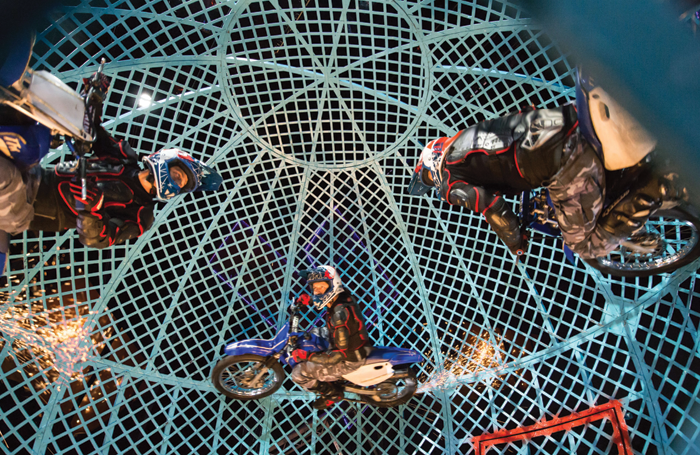
There then in my bed, with all these thoughts (and more) making their rounds in my skull like motorbikes in the “Sphere of Death,” I again turned my heart and attention to Jesus.
“Lord, you see all that I’m thinking. You know all that I need. Where I see question marks, you see exclamation points. You are so far above these situations, and yet intimately involved in every detail of all of it. And I know you care about me and my family far more than I care about any of these details. Thank you for being with me, and thank you for being trustworthy. Amen.”
And with that, I surrendered all the rabbit trails, all their outcomes, all the unanswered questions, all the “what-ifs”, and all the thoughts that would continue to keep me awake.
When I awoke again, it was time to get up and start the day. And more notably, it was from the deep kind of sleep that comes from resting completely in the goodness of God. No matter what rabbit trails you’re chasing today, or what thoughts are uncaged in your heart and mind today, I hope for you the peace that goes beyond all understanding–the kind that can only be found in the loving gaze of Jesus Himself.







 jerrythinks.