Connections Matter

“To lead is to serve.”

That’s the mantra of a group of young people I’m privileged to walk with. This particular group is called “Crew” and it’s our student leadership team. The goal of this team is not to manufacture pastors or full-time ministry leaders but rather to create a sense of ownership and urgency in terms of mission. What’s the mission? Simple. To “make disciples.”

Jesus is the one-stop shop for all things leadership, servanthood, visioning, planning, time management, personal growth, team-building, and organizational structuring, to name a few. You need not look any further than the person of Jesus Christ and His 33 years on earth if you want to learn anything in any of the areas above.

I’m a chronic evaluator. I’ve never been able to leave things alone that could potentially be improved. Sometimes, creating from nothing is involved in that, but most times, it’s taking what already is and asking, “How could this be even better?” And sometimes “better” comes in the form of taking an approach, a paradigm, or an established methodology, tying it to the nearest tree, and putting a bullet in its head. Metaphorically speaking, of course.

Because I’m constantly evaluating and seldom (if ever) fully satisfied, my mind is continually spinning and working on what-ifs, what-nows, and why-nots? I don’t suppose I’m unique in this; I bet you have a fair measure of evaluative DNA in your bones as well.

One of the assessments I’m trying to make right now is to evaluate how emotionally supportive and personally accessible I am. I didn’t wake up with those two areas of growth in my mental crosshairs, but as I’ve thought about it, they have emerged as two possible areas I could do some work in.

I’ve often said that self-awareness is a superpower. It’s one of those things you notice more when it’s absent than when it’s present. For example, my wife and I drove out to the middle of nowhere to a small country furniture store that sold Amish-quality (if you know, you know) furniture, and it was also a deli of sorts that reportedly piled the lunch meats high on their freshly made bread. We didn’t go for the furniture.

While waiting for our sandwiches to be assembled by bonnet-wearing, long-dress-adorned women, another customer approached us to tell a joke. I’m not kidding. No warning. No “I’m about to tell you a joke” disclaimer. No preparation. She just hit us with this quip that she considered amusing.

Have you ever had to make a decision that, in the face of sheer awkwardness, you’re going to just go with it and try and endure with a smile on your face? That was us. Her joke was understandable, but it just wasn’t funny. It was on par with a really bad “dad joke.” We responded with the appropriate amount of sympathy laugh, trailed off with the well-known “after-laugh” sigh that kind of trails off, letting the jokemaker know that their joke was…ummm….over.

Undaunted and clearly unaware of our discomfort, she doubled down with another joke. A swing and a miss. Strike two.

Then, to my horror, she pulls out her third attempt. I wish I could tell you what it was, but it was so bad that my mind instantly protected itself by erasing the memory of that joke.

One thing I can say for this sweet lady was that she was gleefully unaware of the situation as we saw it. She was just doing what she did: cracking jokes and taking names. Yep. Self-awareness is a superpower. And you know it best when it’s absent.

So, all that to say, I want to be self-aware. Sorry, that deli story was the “long way around the barn” as my dad would say. Still, I want to be in tune with areas of growth that present themselves.

I wonder how well or poorly I’ve actually done in these two areas. The areas of support and accessibility, in particular, are, for whatever reason, the two areas that are in front of me right now. I won’t share the details, but I can look back on different situations where I have been either accidentally unsupportive or inadvertently inaccessible.

I titled this blog post as I did because I really do believe that. At the end of the day, it really is connections that matter most. First, I want to be connected to Jesus. And by connected, I mean abiding deeply in who He is, how He loves, and where He’s going. (John 15:4-11) The youthful desire I once had to just “get stuff done” has been slowly replaced by a desire to “keep Jesus close.” I’ve learned over the years that getting stuff done without keeping Jesus close is worth exactly nothing. (Psalm 127:1) I know that’s a harsh statement. But it’s not less true because it’s difficult to hear.

One of the things I love about this young generation is their apparent desire to connect more than accomplish. God bless previous generations and their dogged determination to grind at all costs, and I don’t mean to say that Gen Z or Alpha or even Millenials aren’t hard workers. They most assuredly are. But what is of equal or greater value seems to be connecting well while they also do the stuff on their to-do lists. It’s the beautiful understanding that the program is the vehicle, but the person holds the value.

So, how do I make better connections? How do I increase my accessibility? I have taken steps in that direction and have seen some traction. But what must be in place is the intentional steps of seeing what is lacking or needing strengthening, swallowing your pride, and seeking out ways to improve upon it.

Here’s one thing I’m doing. It’s so simple that I’m sure millions of others have already figured this out and applied this to their daily lives. Since I want my life to be marked by JOY, and since I’m a sucker for acrostics, I’m seeking to live each day with these three things at the forefront of my interactions and connections:

J – Jesus. Jesus is my best friend, my King, my healer, my grace-giver, my companion, and my Lord to name just a few. Because of the love relationship I have with Him, I am guided in all ways to love and to serve as He loves and serves. He enables me by the power of His own Spirit to do that; it is none of me and all of Him.

O – Others. If you know me personally or if we’ve ever even had just one interaction, I hope and pray that I gave you attention, showed you respect, and dignified you as a beloved creation of God. I hope that when we talked, you felt heard, understood, seen, and even embraced. If I fell short of that, I apologize. Let’s try again. I drink coffee every day and eat lunch every day. I’d love to do either of those with you.

Y – You. This one’s interesting because John clearly taught us that “I must decrease, and He [Jesus] must increase.” (John 3:30). So it stands to reason that the less of me there is, the more of Jesus there is. But then again, Jesus Himself taught us to “Love your neighbor AS YOU LOVE YOURSELF.” (Mark 12:31) Do these two principles (me decreasing and me loving myself) conflict with each other? I don’t think so. We must have a God-view of ourselves just as we do of others. One prayer I regularly pray is “God help me to see and love people as you see and love them.” But I’ll confess to you that I do not pray that prayer to include myself when, in actuality, I should. “God, help me to see myself as you see me” is a prayer that I need to put into practice.

What connections are most important in your life? How could they possibly be stronger?

What other areas of your life are you evaluating and strengthening?

Leave some thoughts in the comments.

Discipleship as I see it.

My views on discipleship have certainly evolved over the years. I find it fascinating that Jesus told us to “make disciples” just before he ascended into heaven, but didn’t specify how to do that. We can most certainly extrapolate principles from His life, teachings, and examples but the fact remains that when He told His disciples to “make disciples”, He didn’t hand them a “How-To” guide giving them step-by-step instructions as to how to accomplish that task.

So here we are.

Truth be told… if I really unloaded all my thoughts on discipleship, you and I would be here all day for days and days because I seem to have an unquenchable storehouse of thoughts on this subject. The bottom line is this: Making disciples is literally the one thing Jesus told us to do while He’s taking a quick break on this throne. Do you remember when you were a teenager and your parent(s) went out for an errand and left you with something to do while they were away? Do you remember not doing that thing until you saw the headlights of their car pulling into the driveway because you got distracted or just put it off, thinking you had plenty of time? We often get caught up in the distractions of other things while the “one thing” goes undone.

I’m approaching my 30th year as a pastor. Living a life of full-time ministry (I’ve learned there’s no such thing as part-time ministry, by the way), I have grown in my desire to be sure that the “one thing” we’re called to do is not just getting done, but in the most Christ-like, effective, gracious way possible.

The imagery that I share with the leaders I lead who are leading students in discipleship is this: We are simply placing a loving hand on their back, and guiding them forward into a closer walk of devotion with Jesus and greater degrees of obedience to Jesus. We’re not pushing; we’re guiding and encouraging. The role of someone who is seeking to disciple another must be marked with love, patience, wisdom, and clarity, to name a few. I also use the term “Sherpa” with those I’m leading. No matter who you are, you’ve never been where you are before. You need someone who has. Having a Sherpa who knows the terrain and can guide you is truly the heart of discipleship. Disciple-making can be facilitated or begun by programs, but discipleship is not a program. It is best lived as an eyeball-to-eyeball relationship where we are growing together because we’re walking together with Jesus. I also believe that not only does everyone need a Sherpa, but everyone needs to become a Sherpa to someone else. Or as the well-used expression goes: Making disciples who make disciples.

Since I can’t practically go on and on about this directive of disciple-making to the extent I’d love to in this blog post (because there’s simply so much more to say), I’ll stop short here and simply ask your thoughts on what it means to make disciples, the “one thing” Jesus’ followers are called to do. Please share in the comments!

Bookmarks

I hated reading. I didn’t grow up loving books like some of my friends did. I’d rather crash my Star Wars figures together in some epic battle, or spend hours building with my beloved Lego. In sixth grade, I feigned being a book lover in order to catch the attention of a girl in my class who was toting Tolkien’s “The Hobbit” around. Somehow, I found a copy to tote around, hoping to be noticed. That plan never amounted to anything. Even as I got into high school, I just didn’t enjoy reading. It felt too subdued. Too tame. Too blah.

It wasn’t that I didn’t read. It wasn’t that I didn’t know how. I just found it to be pointless. Then in my senior year, I was in Mr. Mathis’ English class. Like many high schools, ours had an English teacher who was just odd, a man who marched to the beat of his own drum. And yes, he was also in charge of all the theatrical productions that the school produced. Mr. Mathis changed my view of reading and writing. In fact, you are reading these words right now largely thanks to Mr. Paul Mathis. He taught me a love of reading and writing that I haven’t been able to shake. It’s hard to explain, but my fingers flying around this keyboard, landing on letters, and pounding out these words is akin to someone else laying their head back on a therapist’s couch as they let their guard and inhibitions down in a way that is healing, helpful, and hopefully healthy.

If I could draft my own ideal existence, it would be largely centered around the act of writing and reading. In my life, reading fuels writing. In fact, this blog post with its peculiar title “Bookmarks” directly resulted from my reading some words just moments ago. It’s natural for my eyes to go left to right, line after line, reading some random something, and suddenly be struck with the undeniable urge to create some words of my own. So here I am.

The title of this post, I admit, is quite last century. In our digital age, the types of bookmarks I’m referring to are slim pieces of paper that serve to mark our spot. It’s a thing we place where we have to stop so that when we begin reading again we can quickly pick right back up. I have a few favorite bookmarks of my own. I suppose my favorite is one we purchased the last time (many years ago now) that we vacationed on Anna Maria Island on the Gulf of Mexico. There’s a small restaurant called “Rod & Reel Pier” that lives on stilts over the water. It serves fresh caught seafood dishes and other delectable delights. It’s a favorite stop of ours. Some local artist created a watercolor painting of that local eatery and laminated it into a bookmark. Anytime I look at it, I’m taken back to that delicious grouper sandwich.

Bookmarks exist because we can’t read nonstop. Life gets in the way. There are other things to do, to think, to act on, and problems to work out. So the bookmark is a non-digital pause button. We must pause in order to give our attention to other things.

If I’m being completely honest (and I am), I’ve had a sense of placing a bookmark in some desires, plans, and dreams for the past two years. This is Friday morning and I’m sitting in a coffee shop doing what I really want to do: write this blog post. Whether anyone reads it or not is secondary if that. The point is, I’ve long since been under a strong obligation to move from what needs to be done to the next thing that needs to be done. This has been my existence for the past 2 years. Please understand that my life has not been 2 years of doldrums or dragging myself along in a joyless existence. But when I assess the reality as it has been, I’ve been far more likely found taking care of some responsibility and requirement (a need) than I have been able to engage in what I’d like to do (a want). In other words, lots of bookmarking.

But I’m 3 weeks from the end of that 2-year journey. I’m completing my graduate school journey. The only reason I’m not buried in a textbook or writing a paper or working on a project is because earlier this week was Labor Day, so we had a rare week off from assignments being due. But still, in an effort to get ahead, I chose to still do school work this week thereby alleviating as much work from next week. That decision has afforded me a morning relatively free from “needs” and more in line with “wants”.

But all this results in me asking you: What have you bookmarked? And why have you bookmarked it? What is it that’s holding you in the paused posture? It very well may be a legitimate list of reasons (like grad school) and you’ve simply had an enormous amount of responsibilities, precluding you from having much margin in which to chase “wants”. But maybe you’ve bookmarked that step or those plans because you’ve simply allowed life to dictate to you what you’re going to do. I wonder where we got the idea that we are simply victims of circumstance? How did we ever come up with the concept of “that’s just want happened to me and I’ve just got to live the hand I’ve been dealt”? Your bookmark might be more accurately identified as fear, as insecurity, as busyness, as financial stress, or due to lack of connection to others that could propel you toward action. No matter what you call it, see it for what it is.

I know its easy for someone like me to sit here and pound out these words and not be fully connected with your circumstance. I know you very well may have a bagful of “yeah, but” that might negate this attempted encouragement in your life. I get that. But what if after honest assessment, you came to see that there really is a step you can take, albeit a small step? I’m a firm believer that when it comes to unbookmarking, no step is too small. All steps qualify.

So pull that bookmark. Get moving again. And see what happens on the next page.

Introducing: The Pivotal Podcast

This time in the history of humanity and more specifically in the Church is most certainly pivotal in terms of how we are attracting (and repelling) young people. Likewise, young adults enter into an incredibly pivotal time post-high school with all the decisions they face in terms of faith, direction, and community to name a few. It truly is a pivotal season for young adults.

The Pivotal Podcast is a monthly conversation hosted by Andrea Sawtelle & Jerry Varner centered on walking with young adults, exploring unique challenges and joys they face, and opening up a dialogue with young adults for their benefit and the benefit of those who are serving them in ministry and other ways. 

We know the world doesn’t really need another podcast, but this conversation is an important one. It’s one that I know is happening all over, so we’re seeking to create a place for young people to connect, to be heard, to voice their thoughts/convictions/frustrations, etc. And to allow those who want desperately to minister meaningfully with and to them to have a place to hear their heart.

Each month, a new guest to walk with and hear from, but not limited to “Christian” people. We truly desire to have a dialogue about what faith looks like in the lives of young people today.

We hope you’ll join in. If you’d like to be a guest in a future episode, just reach out. Let’s talk.

Listen to Andrea & Jerry share their heart and vision of The Pivotal Podcast at the link below! Soon, you’ll be able to find The Pivotal Podcast where podcasts are found. Simply search “The Pivotal Podcast.” Look for the yellow The Pivotal Podcast graphic!

https://feeds.buzzsprout.com/2391142.rss

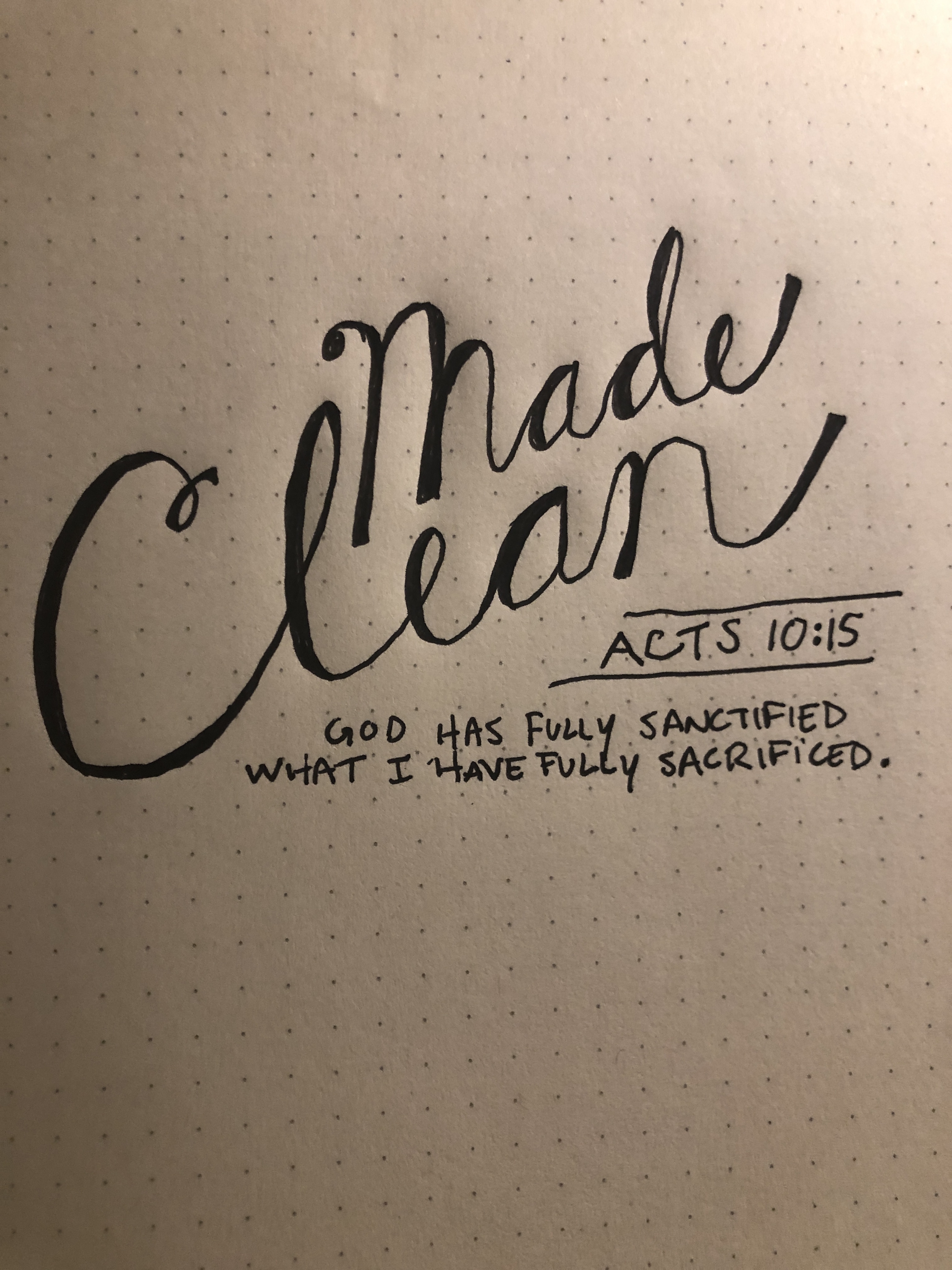
“Made Clean”

Today in a spiritual exercise with a small crowd of others, we listened to Acts 10:9-17. We were instructed to listen as it was read to us and even encouraged to close our eyes if we chose to. As it was read, we were instructed to listen for God’s Spirit speaking to us about a particular word or phrase. This is part of the spiritual practice of “Lectio Divina”, something I have been through before, but it has been quite a long time.

As I listened quietly, calmly, and intently to the passage being read, God’s Spirit did in fact speak to me about a particular pair of words. Before I get to them, let me share the passage with you in its entirety. Read this through twice.

About noon the following day as they were on their journey and approaching the city, Peter went up on the roof to pray. 10 He became hungry and wanted something to eat, and while the meal was being prepared, he fell into a trance.11 He saw heaven opened and something like a large sheet being let down to earth by its four corners. 12 It contained all kinds of four-footed animals, as well as reptiles and birds. 13 Then a voice told him, “Get up, Peter. Kill and eat.” 14 “Surely not, Lord!” Peter replied. “I have never eaten anything impure or unclean.” 15 The voice spoke to him a second time, “Do not call anything impure that God has made clean.” 16 This happened three times, and immediately the sheet was taken back to heaven. 17 While Peter was wondering about the meaning of the vision, the men sent by Cornelius found out where Simon’s house was and stopped at the gate.

Were there any words that glimmered for you? Was there anything that caught your attention or pricked your heart? Think about that word or phrase for a moment. Mediate on it quietly, asking God’s Spirit to speak to you as you listen quietly.

The two words that my mind got stuck on were “made clean”. Peter was essentially arguing with God and refusing to call clean what God had clearly given him. From a religious and traditional standpoint, the things contained in the vision were not clean, even though they were clearly being delivered and offered to Peter straight from God.

These two words speak to the completeness I have in Christ and because of what Jesus has done. Jesus has made me clean. Not only that, but He has qualified me to serve in His Kingdom. This is not a statement of arrogance or pride; quite the opposite. I know I am unworthy of His affection and approval. But because of Jesus’ death and resurrection, I am made clean. I am made whole. I am made fit for service.

I’ve been serving young people and their families in a full-time pastoral capacity since 1995. Even after nearly 3 decades of loving and leading the younger generation(s), I still wrestle with my own worthiness. I still have what some call “imposter syndrome”. I still wonder what I have to offer.

At the age of 16, I pushed the pile of mess that was my life across the table to Jesus and said, “Here. You can have it. If you can’t make anything of it, go ahead.” In that moment of surrender, Jesus took my meager offer and embraced me as His own. He took what I put before Him and ever since then has been working, tinkering, tweaking, adjusting, and transforming me day by day.

I hope that there’s something here that’s encouraging or at least thought-provoking to you. If there’s anything you’d be willing to share, I’d love to hear it. Put it below in the comments.

*If you know me, you know I process through doodling. Above is a doodle from today’s Lectio Divina.

When the Need is Known

For the past 8 days, I’ve been in upstate New York with a group of high school students. It’s always so amazing what happens to relationships when they’re put into that kind of context. We spent most waking (and sleeping) hours together. We saw some incredible sights (like Niagara Falls), met some incredible people (Like Sal & Mama Maria), and we were given opportunities to do some incredible things. 

One of our students had an accident on Monday and long story short, I spent 2 days straight with him in a hospital room. Soon after arriving, I realized I had forgotten deodorant. Not sure if showering would even be an option for me, I really knew that deodorant would be extra important! Thankfully there was a CVS right next to the hospitial, so I walked over and found the deodorant aisle. But when I found the deodorant, I was surprised to see every deodorant under lock and key. There was a big red button (pictured here) to push if you needed help. So I pushed it. Loudly over the speakers, a recorded message declared: “Assistance is needed in the deodorant aisle! Assistance is needed in the deodorant aisle!” I gotta admit: I was a little embarrassed that now the entire store knew that I wasn’t just in need, but that I was maybe not smelling my best. 

I stood there for a couple minutes, waiting. No one came. I thought about pushing it again, but one loud announcement for all to hear about my armpit needs was quite enough for me. So I headed to the front of the store to find someone to help me. I found a store worker and asked for help, so he followed me back to the locked glass case and opened it for me. As he did, he said, “You know, there’s a button right there you could have pushed.” I couldn’t help myself: “I DID!” I responded. “Oh. Sorry. I was busy.” was his reply as he walked away.

We don’t like people to know our needs because, well, then people will know our needs. And they’ll know we actually have needs. And that can only lead them to know one more thing: We’re not perfect. We humans tend to keep our needs to ourselves, thinking that we’ll be looked at differently for having needs at all. Where in the world did we get this idea? I think I know, but I’d like you to think about that for yourself.

Are you living like that store worker, too busy to hear the needs of others being announced around you? Are you too self-absorbed with your busy schedule, your laziness, or your distractedness to even be able to hear the needs around you? This week, try to be intentional in looking for and finding needs God can use you to meet in someone’s life. 

Rebranding

In the conversations I have, hear, read about, and am surrounded by through trainings of various kinds, I can’t tell you how many times the term “post-Christian” has been used to describe American culture in 2024. And while I don’t disagree that we are, as a people, moving undoubtedly toward a reality uncoupled from religion and its vices (and faults), I do not believe we are a people who will ever be without the moorings of spirituality. So where does that leave us?

In the evangelical Church’s efforts to spread the gospel in American society over the past 70 or so years, we have accidentally instead created a structure, an institution, a set of expectations, and even a reality where some are definitely “in” and some are definitively “out”. Here’s the problem: This is all wildly divergent from what Jesus had in mind and more to the point, what He instructed His followers to be and to do. Let’s call it what it is: the biggest, most damaging “oops” in the history of the world.

If you’re someone reading this who would say that you love Jesus (most people do, actually), and if you’d say that your love for Him has radically changed your life and everything in (a vastly smaller crowd), then you might be wondering how the Church might right the ship, so to speak. How does the largest organization in the world rip itself from its status of even being an organization?

First, I believe it starts with moving away from using the term “post-Christian”, which ironically, at least in my experience, is a term only used by Christians. The term may very well be addressing the current perceived reality, but it also is a backwards-facing term. In essence, it speaks to what was more than what is. It’s a term that will keep us on the front porch, rocking slowly in our rockers, reminiscing on the “good ‘ol days”, even though how good they actually were is debatable. So, dropping the term “post-Christian” is a good first step. It isn’t serving a good purpose in any direction.

Instead, we ought to seek to understand the cultural view of Jesus. Not church, not religion, not spirituality, not faith, and not morality. To be blunt: We the people don’t know Jesus. We have a wrong view of who Jesus is. We have a concocted version that is often in stark contrast to the truth of Jesus. In other words, we have our own version of a Jesus we’ve made up, and its inaccurate. That’s not only A problem, but I believe it’s THE problem.

If you’re a follower of Jesus and you need something to label American culture with, how about the term “pre-Jesus”? Where post-Christian looks back longingly, pre-Jesus looks forward hopefully and purposefully. Pre-Jesus unhitches us from the constraints of the past; things that have taken us down rabbit-trails that have led to Christians building walls instead of bridges. The view that America is now a pre-Jesus culture gives us nothing but opportunities. Not to preach with a bullhorn, but to serve with a towel. Not to indoctrinate with a program but to influence with a purpose. Not to push an agenda but to point to a Messiah.

The fact is this: America actually DOESN’T know Jesus. And what the average person thinks they know isn’t correct, so it isn’t helpful. The foundational good news is that most Americans believe Jesus was a real person–that He actually lived here on earth. That’s incredible news and it’s where we should start. According to Barna research, every generation in recent history (last 100 years or so) has a strong belief in the historical truth that a man named Jesus (the one found in scripture) actually walked this earth. Millennials represent the lowest percentage of generational belief, but even they’re at a strong 87%. So anytime you talk to anyone, you can START with a minimum of 87% confidence that that person believes Jesus was a man in history.

What happens next to those percentages is where some of the difficulties start. While most believe that Jesus was a human, far fewer believe He was more than a human. Far fewer people are sure that Jesus was (is) God. If Jesus was only human, we can stop here and simply laud him as a good teacher and a man who did nice things before being accused and executed. End of story. If Jesus was just a man, we can rightly place him on the shelf next to Gandhi, Buddha, Lincoln, Martin Luther King, Jr., and Mother Teresa. Good people who did good things and then died.

What we must do in our pre-Jesus understanding of American culture is to correct the wrong perceptions of Jesus, paint a better picture of Jesus, and then invite people to be personally embraced and transformed by Jesus. Again, church activities have their place, but emphasizing joining a group over embracing a Savior will only lead us down the road we’ve trod for decades. Our pre-Jesus perspective opens up the doors of opportunity for those who know and love Jesus to live lives that place His nature and character on display in daily, authentic ways. Look at the life of Jesus and see how often He got dirty loving people. It was almost non-stop. Yet to many today, being a “Christian” is little more than cleaning ourselves up once a week, going to a sanctified, tidy location, and repeating a structured regiment of words and songs we’ve created largely for our own entertainment.

The pre-Jesus mindset looks at our culture with wonder and zeal to introduce America to the real Jesus. We get to reframe the common misunderstandings about Jesus and misgiving about His bride, the Church. We get to love one another well, and in doing so establish our strongest apologetic. We get to see each person as Jesus Himself sees them; worthy of His shed blood regardless of their complexion, their income, their status, their ability, their beliefs, and their habits to name a few. We get to be the very representation of the gospel of grace in the world around us.

*What I’ve shared here has been largely nothing more than my inner dialogue up until now. What are your thoughts on any of this? Do you see any differentiation between the concepts of post-Christian and pre-Jesus? Where do you see the church’s efforts falling short? Where is the gospel advancing in your life as you seek to serve others? I’d love to hear your thoughts.

(If you’d like to read more about common beliefs about Jesus, check out Barna’s research here.)