
Changing Lanes?

To talk about the topic I want to bring up feels (to me) to be somewhat risky. The main–and maybe only–reason is because it’s rather open to interpretation and others feeling that I’m saying or thinking something I’m not. So I suppose I ought to cover this with disclaimers and caveats in hopes that anyone who reads this doesn’t receive a message I do not intend to convey. I should further say that this post will be most relevant to those who are serving in ministry, primarily full-time ministry. Not exclusively, but perhaps primarily.

I think some backstory might be helpful to establish (maybe) some of the reasons I see things the way I do, and why I find myself wrestling with those things regularly. I had kind of a weird upbringing that has shaped who I am today. When I say weird, I truly mean just that. Not bad, nothing negative, not regretful. I certainly don’t wish I had a different upbringing. I’m thankful for my parents and all they have done to show me love, teach me truth, and do their best to raise a kid into a man.

I recall that day in elementary school when everyone was sharing what their dad did for a living. (I wonder if teachers could get away with that now.) I remember the nervousness I felt when I realized that I was going to have to tell the class that my dad was a pastor, what kinds of questions I would have to hear, and how my young mind might not be able to formulate answers that really even made any sense to me, let alone anyone else. By the way, the only thing I remember from that class where I had to tell everyone what my dad did for a living was how mesmerized the teacher was that my dad’s initials are REV, since he was a reverend.

My dad pastored a small Baptist church in North Cape May, New Jersey. I remember in 1979 when we moved from North Carolina to New Jersey which to me at the time felt like moving to Jupiter. But my dad was “called” to go there, and he obeyed that call. So to Cape May, New Jersey we went; my parents, my two older sisters, and little Jerry who was just barely in first grade.

The move from NC to NJ was out of my hands. The call had come calling and my dad heard the call and answered the call. It was as if, it seems, our collective hands were tied with a rope called “calling”. What was he going to do, not answer the call? What would that say about his willingness to be obedient to God’s call on his life?

We never moved again as a family. And in case you don’t know, that’s weird (really weird) for a pastor and his family. The average stay for a pastor at a church in America is four years. FOUR. So statistically speaking, I should have moved again to only-God-knows-where in the fourth grade. Statistically, we should have moved again in 1983, 1987, 1991, 1995, and…you get it. But we didn’t. I graduated high school and left for college in 1991. My dad was still…STILL the pastor of that little church in North Cape May, New Jersey, and pastored there faithfully until 1998. That means that my dad pastored that church as long as I’ve been at the church I’m at now: 19 years. So needless to say my point of reference is that 1) pastors stay at their church for long stretches of time, far more than four years, and 2) if and when pastors move, it’s because the mighty hand of God, like a chess master moving a knight on the chessboard, deems it necessary. And much like those chess pieces, no one moves until they’re moved.

So that’s my understanding of pastoral ministry, pastoral calling, and pastoral longevity. So when I sensed and answered my own call to ministry, I had in my mind that I’d end up pastoring a little church somewhere and decades later if you chose to check on me, I’d still be there in that same place, faithfully serving. After all, that’s all I knew.

Fast forward to today. My ministry tenures since graduating college in 1995 have been the following: Church #1: 2 years (in Winchester, VA), Church #2: 7 years (in Nyack, NY), and now closing in on 20 years on Church #3 in Chesterfield, VA. And I’ve moved as often as I have when God moves me. Who’s got 2 thumbs and feels like a chess piece? This guy.

So here’s the question I wrestle with: Is that how pastoring works? Do I simply stay put and remain until such time that the hand of God pushes a door open and the voice of God orders me through it? Nearly thirty years into this life and I still wonder that. No one ever taught me otherwise, so I’ve learned what life has shown me.

Where does my desire intersect with God’s will? As a matter of principled fact, my default setting is found in Galatians 2:20: “I have been crucified with Christ and I no longer live, but Christ lives in me. The life I now live in the body, I live by faith in the Son of God, who loved me and gave himself for me.”

So to answer that question “Where does my desire intersect with God’s will?” is the answer, “It doesn’t, silly Jerry. You’re a crucified dead man. And dead men don’t have a will.” Or is the nature of God more accommodating than that? Is the fatherly character of God to want to both lead His children and give His children the desires of their hearts? I wonder this not only for myself but also in hopes of helping new pastors or those wrestling with the idea of calling to be able to have a place to discern and develop convictions for themselves.

So my heart also knows and recites Psalm 18:19: “He brought me out into a spacious place; he rescued me because he delighted in me.” And also Psalm 37:4: “Take delight in the Lord, and he will give you the desires of your heart.” How do these very real and very true verses from scripture jive with a crucified Jerry who, truth be told, can sometimes have a sense of stuckness, waiting for God’s next move?

Here’s where I feel I should reiterate what I started with: Don’t read into what I’m saying here. I’m not living with “the grass is greener” thoughts in my head. I’m not quietly and secretly planning anything. If nothing else, I’m transparent. I don’t have any hidden agenda. I’m not being subversive. I’m just verbalizing (typing) the thoughts I have. Especially if you’re part of the ministry I’m serving at now, don’t think “Jerry’s about to leave and this is his weird way of telling us.” Nope. That’s not true. In fact, I hesitate to even publish this one because some misunderstandings are more likely with this blog post. But again, I feel it’s a conversation worthy of having.

It may be more prevalent in my life in particular right now because of the crossroads I’m quickly approaching as a dad. Two of my kids are currently living in another state, one of them getting married in under 90 days. So naturally, I’d love to be nearer to them (and potential future grandkids). I’d love to be inside an hour away from them, not the current 8-10 hours away. But does God look at that and say, “Tough cookies, Jerry. You said yes to Me and My will, and I say you’re staying put. Suck it up, buttercup.”

Or does the nature of God provide far more leeway than that? Does following Jesus mean that He also cares for me AND my availability to His Kingdom’s work? I wonder how many pastors would respond with a resounding “You stay there until God moves you. Period.”, and how many would say, “God has blessed me and my ministry efforts regardless of where I am because He’s a good God who cares far less about geography than we do.”

Jesus said, “Follow Me.” and I don’t want to ever flip that around to me saying, “Jesus, follow me.”

What interaction does calling have to do with personal will or even…dare I say it…ambition? Make no mistake about it; my life’s ambition is to point people to Jesus. That’s it. If you attend my funeral, the eulogy can be very short indeed. If it’s true, just say, “Jerry pointed people to Jesus. Let’s close in prayer so we can get to that table of food over there.” So don’t think I’m some pastor over here with itchy desires to do something radically different. Nope, that’s not it. I just wonder where the line is–or if one even exists–between what God is calling me (you) to do and how I (you) make decisions of obedience in regard to that.

Here’s where I’ll leave it. I’d love to hear your thoughts on this. Not just if you’re a pastor in ministry, but if you’re a follower of Jesus. I know every follower of Jesus lives by a calling on their lives. I know calling isn’t just for pastors or missionaries. If you’ve hung in there and read this post to the end, know that that’s a big deal to me. If I can be of any kind of encouragement or help to you, just let me know.

Bonus (?): Nowhere in my formal education were concepts of discernment taught. I wasn’t given any tools in terms of developing convictions on how to understand my calling. But as I said, it’s the central issue that has determined the trajectory of my life. I hope I’m not overstating or making more of this issue than it’s due.

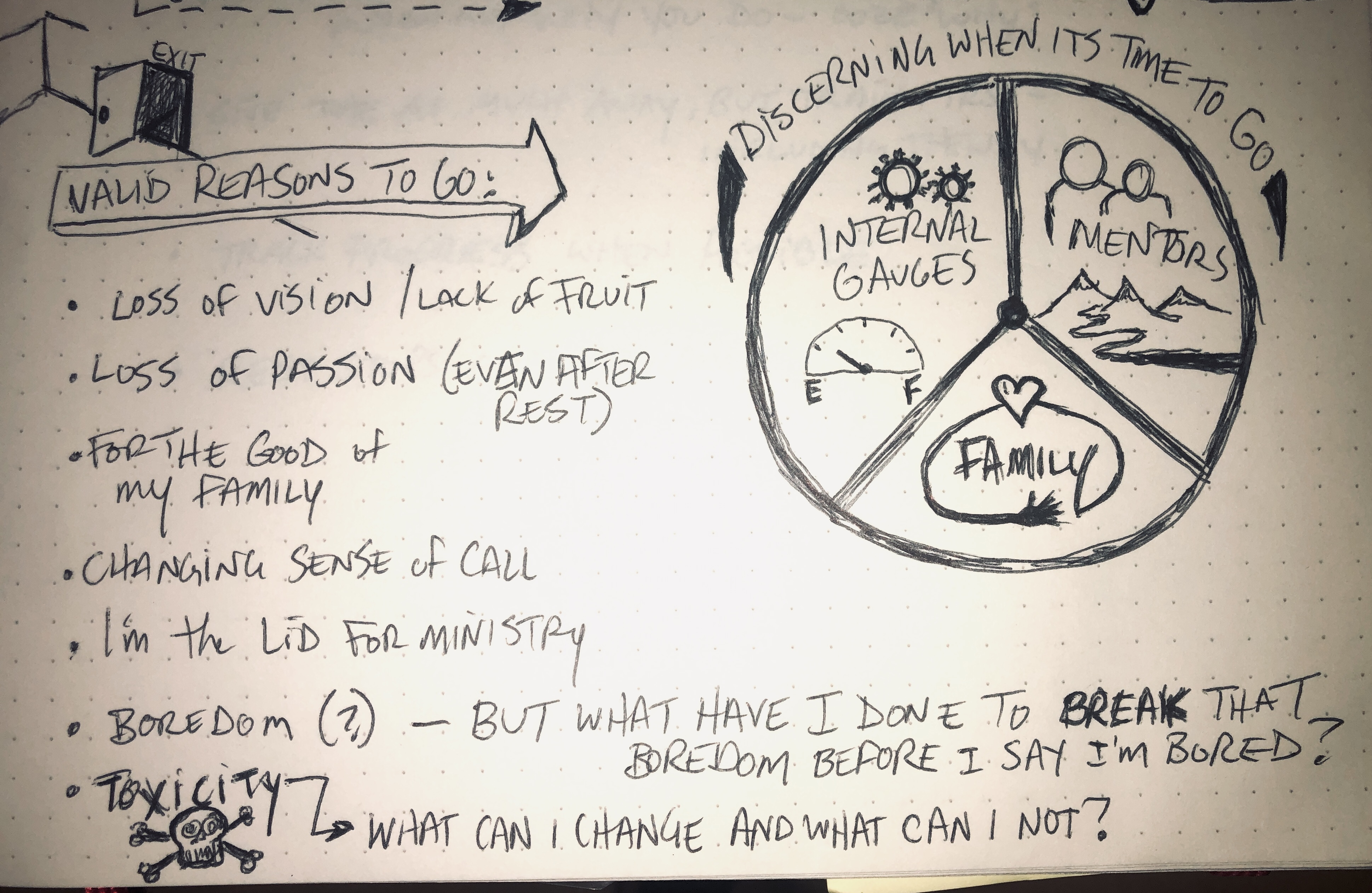
*I’ll include some doodles/thoughts I made years ago as even then I was grappling with this whole idea of calling, being in obedience, living practically, and making wise decisions. For what it’s worth…
The Science & Systems of Romance

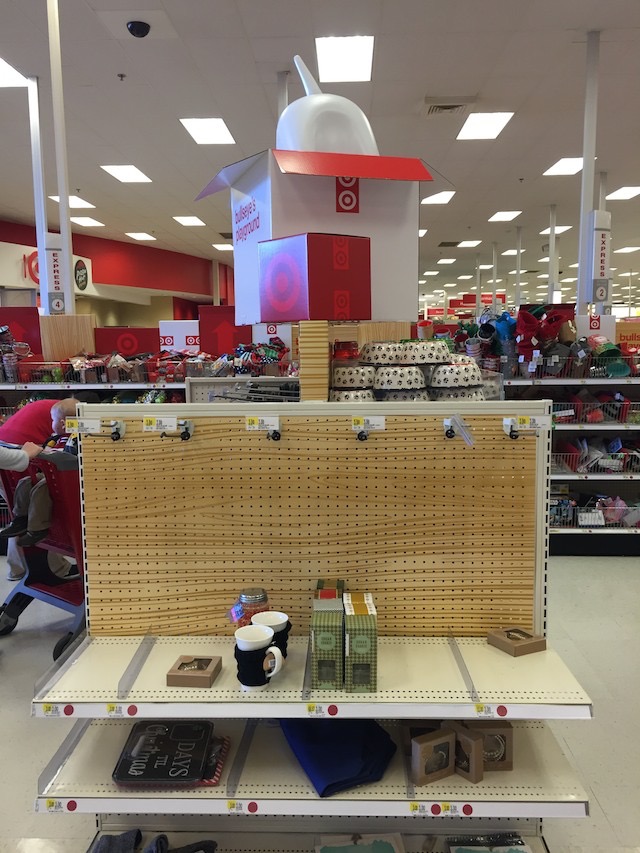
My wife and I swung into our local Target on December 26 to see if we could spy any sweet after-Christmas bargains. When we walked in, we saw that “One Spot” area that I think is standard issue at all Targets everywhere. I noticed two things immediately: 1) there was absolutely no sign of Christmas decor anywhere–it was all Valentine’s Day stuff and 2) the Valentine decor/gifts/knick-knacks were ALREADY picked over and shelves were mostly bare.

I made a statement to a crowd this past Sunday night at our church’s Christmas Eve service. I was making the contention that I think we’re doing the Christmas season wrong. Maybe wrong is too strong a word, but there’s this cultural thing we do where late October and early November we start to get this buzz of excitement for Christmas going. Our local radio station switched to all Christmas music on November 15, and from then on it was a growing crescendo until daybreak on December 25th. But then, it’s a hard shift, and all things Christmas seem to vaporize. What’s wrong with that? I mean, technically nothing. After all, once the 25th passes, what’s the point of having a tree, or lights, or Christmas music? And true to form, that same local radio station switched back to its mix of “today’s hits and yesterday’s favorites” on December 26th. What’s “wrong” with that? Well, it seems that we front-load the hype on Christmas but once the 24 hours of December 25th pass, there’s not much left but scraps of wrapping paper and extra cardboard in the trashcan by the curb. We quickly move on. People like me who prefer to linger are left with a “that’s it?” kind of sensation.

I understand this is largely cultural, but there can also be a spiritual dimension to it. The whiplash we get on the morning of December 26th is precisely what is expected, based on how we generally view the 25th. And after all, it’s over so why would we do any different? All that is real and true. I am also aware that those who follow Jesus (not necessarily those who call themselves “Christians”) operate under a different cadence than the world around them, as they should. I understand that to them (us), December 25th holds no more significance in terms of celebrating Jesus than any other day does….or should.

So here’s where my thinking is at today. How do I/we create, cultivate, and maintain a passionate love relationship with God? Does that question come across as weird to you? I’m a rather organic-leaning guy when it comes to faith and spirituality. I generally don’t employ rigid lists of do’s and don’ts in my faith walk with Jesus. But I must confess to you that their absence has sometimes gotten me into stale and dry places I didn’t intend to be with my faith. If I want my life to be a continual love affair with God incarnate, Jesus Christ because of the acknowledgment of faith for what He did for me (and for you) through the manger, the cross, and the empty tomb then there has to be some sense of “best practices”, and not just “let’s see what happens”, right? In other words, if I don’t build structural plans into my heart’s desires, will they ever be more than desires?

Let me make clear here that I’m not looking for a perpetual mountaintop existence. That’s neither realistic nor biblical. I understand the part that “A long obedience in the same direction“, as Eugene Peterson puts it, plays in our spiritual lives.

So I’m going to lay out some structural plans that I’m implementing in my own rhythms. Like I said, I’m not an insanely rigid/regimented kind of follower of Jesus. But I do see that if I want any relationship to flourish, I have to create some sense of organization so that I’m doing all I can to have happen what I want to have happen.

First, I’m dedicating time each morning to worship music. Music for me has the ability to straighten out my spiritual/mental cross-eyedness and fogginess. It helps recalibrate my attention on truth and on God’s presence. Maybe you can relate. I’ve invited anyone to join in with a little thing I’m doing in 2024 called Morning Worship. I’ve created a playlist on Spotify under that name (search for the name/graphic included here) and I invite anyone to send me a song suggestion to add to it; as long as it’s a song that has a special ability to speak to where you are spiritually, or encourage you spiritually in some way. You can comment below, DM, or email me. I’ll add your suggestion(s) to the list and you’ll also get to experience a wide(r) variety of great worship songs that others enjoy. THEN, commit for January to dedicate AT LEAST 10 MINUTES of your morning routine (showering, breakfast, commuting, on the bus to school, etc.) to listening to worship music. See what it does for your mindset as you start your day, and see what impact it has on your outlook.

Next, I want to foster more spiritual conversations. I think spirituality has reached the level of politics in our culture today and that has been to our detriment. I want to–in as unweird a way as I can–open up doors of conversation about spiritual things. I have found over the years that who we are spiritually is who we are. There is no relational ground that is deeper than when I get to speak to someone about spiritual things. Ironically enough, when people learn that I’m a pastor, it seems that doors shut more than open. I’m not sure why that is, but I’d love to reverse that. Let me tell you a little about me in order to grease those gears: I’m a creation of God. I am an inherent image bearer of the Divine. I am seen by Him as precious because of the single fact that He made me as He desired to. Yet, I am also very keenly aware that my tendencies are toward selfishness, and that selfishness brings all types of brokenness. My sin condition creates a divide between me and my Creator. Enter Jesus. Jesus is God incarnate and He alone has bridged the gap between holiness and humanity. By faith, I receive the gift of His love shown perfectly through the sacrifice He made on a Roman cross of crucifixion where He died willingly for the sins of the world. Even mine. Because He conquered death by resurrecting three days later, He alone holds the power over sin and death. And because I have chosen to place my faith in that victory, that victory is also my victory. So my life now is simply to walk in the spiritual victory afforded me by the selfless love of God my Creator, shown through Jesus, my Savior.

Now. What part of that did I attribute to my own wisdom, my own intelligence, my own ability to work hard enough to gain something…anything good from God? What part of that drips with ego? What part of my testimony props myself up as the hero of my own story? I hope you’re picking up what I’m putting down here. I am a child of God because God has shown the whole of humanity grace through Jesus and His voice has called/invited me into a love relationship with Him, and I have responded. That’s it. None of me. All of Him. That’s my story.

NOW. Back to spiritual conversations. If you want to talk with me about anything; belief, disbelief, atheism, agnosticism, pantheism, church hurt, justification, election, redemption, adoption, regeneration, sanctification…or anything about how this beggar was given bread and now shares that bread with others…I’m game. No pretense. No agenda. No debates. No religious talk. No arguments. Just people talking about the most important part of being human that people can talk about.

The next part of my structural plans has to include subtraction. I plan to jettison what isn’t producing what God desires in my life. If you hold a job, ask yourself, “Based on what I know, what I do, and what I contribute to this job, would I hire me?” I think it’s an important and not unspiritual practice to evaluate where things actually are. Careful here, though. This isn’t about a grade or assessment that affects your standing with God. All that is “hidden with Christ in God” as Paul told the Colossians. That’s untouchable. But I do think it’s necessary to keep a pulse on what your faith is actually doing in your mind, in your heart, in your attitudes, in your priorities, in your decisions, and in their outcomes. When I step on the scale in the bathroom, I know that the number displayed doesn’t tell the WHOLE story, but I do know that is tells PART of the story. So when I respond to that number, I can shrug and say “It is what it is” or I can decide to tweak and say, “Okay, today it’s gonna be only water…or no extra sugars…or I’m gonna take an extra long walk with Winston…or its gonna be 2 meals instead of 3 today…” You get the idea. Assess where you are and where you want to be and make some tweaks. What do I need to lose in order to gain what I want more of?

You can’t see me or think my thoughts, but it’s about this time in writing that I become fully aware that this is becoming a lengthy blog post and I begin to idolize and deeply appreciate those who’ve read this far. A professional blogger would tell me to chop this behemoth up into several days’ worth of content. Fair enough.

The bottom line is this: If I want romance in my life, it isn’t going to happen without structure and system. We are people who have concocted this idea that romance just appears and whisks people away into a euphoric spiritual, emotional wonderland. I have not found this to be the case. Romance is work and happens as we do the work it requires. With Valentine’s Day approaching (as our local Target so clearly reminded us), we can think along the lines of familial, platonic, or marital/erotic love (technically speaking), but we would also be wise to apply the science of structure and systems to our spiritual love relationships as well. To leave this core aspect of ourselves to chance is patently irresponsible.

If you’ve read my blog for any length of time before today, you know there are some blog posts that are just untidy and don’t give a sense of being wrapped up with a bow. This is one such post. It’s meant to trigger thinking for me and for you too. Please share your thoughts in the comments and let’s keep this conversation going.

Whip It Good.

It’s Christmas time. Lots of frivolity, merriment, and holly-jolly going on. There’s no better time to talk about anger, rage, and indignation, don’t you think? Something I’ve thought a lot about but written precious little about is the fact that the God who made us (whether you believe in Him or not) is a God with the capacity for anger. And it’s my personal opinion as a follower of Jesus that not enough followers of Jesus have a good understanding of the benefits of anger. That’s right: benefits. So let’s get into this.

It seems you can open up to almost any Old Testament (that’s Genesis through Malachi) and without much looking you can find a situation where God’s wrath (or at least seemingly grumpiness) is being seen. I’ll be the first to confess that it can be a challenge to reconcile what seem to be two different sides/aspects/faces of God when you look at the Old and New Testaments. It appears that God was sometimes vengeful and sometimes benevolent. I get that.

What I want to do is take a look at a situation in the gospels when Jesus came into the temple courts, what he saw, and how he responded. But first…

Have you ever witnessed a true overreaction happen? When the way someone was responding to a situation was completely disproportionate to what the situation actually warranted? If you’re a parent, I’m sure you’ve seen your little one (or yourself) have a complete meltdown over what in your eyes was a normal everyday inconvenience; a block tower falls over, a spoonful of peas hits the ground, a stubbed toe, a red light when you’re in a hurry, the shelves being empty of the one ingredient you needed, the boss bumping that deadline up a day, or any number of daily “grievances” that can just set us off. As long as there have been reactions, there have been overreactions. Raise a hand if you’ve ever overreacted to anything at any time. Yes, I see those hands. Thanks for your brave honesty.

If you read in John’s gospel, chapter 2 you’ll see some incredible things happen. First off, we see Jesus’ first public miracle at a wedding in Cana. There’s so much happening there but its what happens soon after that I’d like to focus on for a few minutes. You can read the specific passage I’m referring to here. It’s John 2:12-17.

Let’s get right to the juicy part, shall we? Verse 15 tells us “So he made a whip out of cords…”

While we’re unclear as to the actual material Jesus used to craft this whip (whether plant, rope, or leather), we can see clearly that he “made” a whip. Being God, He could have certainly summoned a whip to appear in His hand but the word used for “made” is more indicative of something being produced, created; something being accomplished. In other words, Jesus took His time with His anger. He thought it through. He responded with anger that was holy and right. So we can reasonably figure that Jesus’ response to the scene He saw was not an anger that was moody or unhinged; rather His anger was calculated, controlled, and purposeful. We can say that Jesus whipped it. Good.

The reason for Jesus’ anger was that there was a violation of the sacred happening right in front of Him. The space designated for worship, for offerings, for fellowship, for community, and most of all for prayer was being adulterated and used for the sale of goods, commerce, business, for profit. Thieves in the form of merchants had infiltrated the holy temple and Jesus simply wasn’t going to tolerate that.

So Jesus took a breath, found some cords, maybe even sat down, and created a whip with which to address the situation. And by “address” we mean coin-scattering, table-flipping, and raised-voice behavior. In other words, Jesus was TICKED.

What angers you these days? Your first stop is to ask this revealing question: Is what I’m angry about and how I’m responding worth the level of anger I’m giving it? Just like we can misappropriate funds into a bad investment, we can misappropriate energy into an unworthy situation. Anger isn’t the problem. Misspent anger is. Search the scriptures and you won’t find the words “Don’t get angry.” Nope. They’re not there. What you WILL find are the instructions “In your anger, do not sin.” (Eph. 4:26)

So what gets you angry? What is going on in our world that triggers table-flipping and coin-scattering? Are you confident that the response it’s eliciting from you is calculated, controlled, and purposeful? If not, how did this thing reach such a level of importance in your heart that it would receive a disproportionate amount of your emotional energy?

If I may, I’d like to suggest that the list of things that would cause us to flip tables should be rather short. Here are mine: racial injustice, exploitation of any human for any reason, when I (and/or others) know better but don’t do better. And because it was true for Jesus, we can safely add that it is okay to be angry when prayer loses a place of priority in our lives, communities, and worship.

By contrast, here are things that have no right triggering anger within me: having to wait in line, traffic frustrations, when others disagree with me, when I feel someone is speaking inaccurately about me, when things don’t go as I planned/think they should, comment sections, being overlooked at work, the good fortune of others, and plenty of others.

I’ll ask again: What’s getting you angry that really shouldn’t? Jesus was angered; flipped tables, scattered coins, and raised His voice when prayer was undervalued. So prayer needs to play an integral role in us recalibrating our priorities when it comes to what makes us angry and what doesn’t/shouldn’t.

“It’s not about you.”

I suspect that I might raise some eyebrows with this one.

I’m sitting in a small, local coffee shop that I love to frequent. The coffee is incredible and the baked goods are always delicious. About six feet away from me is a table of about 10 men that are obviously gathered around for some type of Bible study or devotional they’re doing together as they build community and relationships through accountability and mutual encouragement. Each of them is sharing their thoughts on whatever passage they’re reading from the Bible. It’s a nice scene and I’m glad to see spiritual things out in the open as part of the public conversation. Regardless of your spiritual convictions, I hope you at least can agree that we are not merely bones and organs encased in flesh, but that there is a spiritual dimension to us humans. We really are more than what we see.

I just heard one of them share four words I’ve heard countless times over my decades of walking with Jesus among others who are walking with Jesus. These four words especially surface when people are talking about their own understanding of the Christian’s mission on earth or even the purpose of corporate worship gatherings. The words are “It’s not about you.” It’s the Christian response to what seems like selfishness, or something we say when we’re inconvenienced, or something we remind ourselves (or the pastor reminds us) of when the church music isn’t just the way we like it, or when the sermon the pastor preaches seems to be more evangelistic than deep-discipleship focused. This mantra has been used to ward off what seems like misaligned opinions of everything from doctrine, to how we conduct ourselves among our neighbors, to what we do (or put up with) when we gather together for worship.

*A quick Google search of “It’s not about you” reveals humanity’s fixation with these four words in all kinds of contexts; even in corporate profits, in retail sales, and in self-help arenas. I’m not surprised at how we have built these four words into an industry of sorts.

But here’s the thing. I don’t think the sentiment “It’s not about you” is entirely biblical. Hear me out. Let’s bring it back to what might be considered the very centerpiece of the story the Bible tells: The cross of Jesus. Who was the cross for? YOU. You are the reason Jesus came to earth. YOU are the aim of God’s mission of redemption and salvation. YOU are the apple of His eye and the object of His affection. When Jesus was whipped, torn, pierced, bleeding, and hanging on the tree He had allowed Himself to be nailed to, it was YOU who was on His mind. This truth cannot be overstated. But I don’t think you’ve thought nearly enough about that reality. Jesus is the “darling of heaven”, but YOU are the darling of Jesus’ fiercely-focused love.

Do I think the cross and the work done there to save humanity is a license for us to build our lives looking out for ourselves and having some type of spiritualized ego that makes much of ourselves while neglecting others? Absolutely not. But I DO think that when you see, appreciate, embrace, and reconcile the fact that the cross of Christ was about YOU, then you are free to love people with a love that is in line with the eternal love we’ve been shown. We won’t and we can’t access that love unless we truly accept that the cross, the love shown through the sacrifice of Jesus there, IS about you.

Yes, I know the words of Jesus regarding losing yourself, self-denial, taking up your cross, and the words “I must decrease, He must increase” spoken by John in his gospel writing. Needless to say, there’s lots more on my mind about this and what this mindset leads to, but I’ll stop here. I’d love to hear your responses to these thoughts.

The Tie That Binds

I woke up today with a VERY old hymn playing on hard repeat in my mind. Why? I have no idea. But because it was so strong and so clearly blaring in the ears of my mind (does a mind have ears?), I thought maybe I’d try and poke at these lyrics and see what comes out by way of spiritual encouragement for us all.

If you’ve read much of this blog or been walking with me for a while, you know some of my story. I grew up a “son of a preacher man” and so my earliest memories are fully immersed in the context of a small, independent Baptist church. You can look it up on Google maps if you want. It at one time was called South Jersey Baptist Church–SJBC to insiders–but now it’s called Good Samaritan Baptist Church.

As a youngin’ who grew up in that setting, I learned all the songs; always accompanied by that tinny-sounding upright piano, with Mr. Faith (yes, his real name) playing on the keys each Sunday morning. The song pounding in my head today that takes me back to good ol’ 307 Townbank Rd. was “Blest Be The Tie That Binds”. Sing along if you know it…

“Blest be the tie that binds…our hearts in Christian love
The fellowship of kindred minds….is like to that above.”

There are 5 other verses, but honestly, I think we only ever sang that one. It was really more of a diddy than a song, really. More of a single stanza than a full hymn, at least the way we did it.

So there I am in the shower this morning, “Blest beee the tiiiiie that biiiiinds…”

The first place my mind goes is to Jesus’ prayer for His disciples AND for you and for me (included in that high priestly prayer): “I pray that they will all be one, just as you and I are one—as you are in me, Father, and I am in you. And may they be in us so that the world will believe you sent me.” (John 17:21)

How tight, how close, how intimate is that level of unity? There’s nothing closer than to share the same heart, the same focus, the same passion, the same direction as God the Father shares with God the Son. And it’s God the Holy Spirit that makes this level of unity possible.

Is there disunity among us as followers of Jesus? The answer, I fear, is an emphatic yes. However, the next question must be addressed and answered: Why? Why–when Jesus Himself seemed to plead for this level of unity–why are we not as unified as Jesus desires us to be? I can say that I believe in principle we are, but in practice, we aren’t.

So what IS the “tie that binds”? Is it not the fact that each of us draws our salvation, reconciliation, redemption, forgiveness, and justification from the same place; the very cross of Jesus Christ? And what is it that works against our unity as His followers? And do those things have any right to carry the weight we often wrongfully give them? What’s working against the “fellowship of kindred minds”?

I’d suggest to you that it is our unity that will present our most potent apologetic to the truth of the Gospel story. It is the togetherness, the oneness among His people that will declare to the world that we are His and His is ours.

I conducted a wedding ceremony yesterday. Officiating weddings is one of my favorite things to do as an ordained minister. There’s a holiness, a solemnity, a sacredness at the wedding altar. There’s a unity that is born that is reflective of God’s own unity with Himself in eternal community. We touch the divine in such sacred covenantal moments. Do we see our brothers and sisters washed in the same blood in this way? Do we uphold unity above all else? If we do not, we do not uphold the Gospel and the ministry of reconciliation we have been given by our Reconciler.

This will be one of those hard stops. I’ll end here and ask your thoughts on this issue of Christian fellowship and unity among believers. Where do you see fractures? Where do you see unity? What are some steps we can take together in Christ?

A Brush With Greatness

I’ve had a number of run-ins with celebrity types over the years. I’ll admit that you might not recognize many (or any) of these people, but at the moment it happened, that “brush with greatness” was memorable.

When I was in college, somehow we had Oliver North come and speak at our school. I had the chance to ask the final question of the Q&A session at the end of the night. So I asked him what his favorite (or most cherished) scripture verse was.

On two different occasions, I ran into Alan Ruck. Alan played “Cameron”, Ferris Bueller’s best friend in the 80’s cult classic “Ferris Bueller’s Day Off”. He also played “Rabbit” in the hit movie “Twister”. The second time I saw him was in a grocery store. I got up the gumption to actually invite him to a theatrical event at the church I was pastoring at. Imagine that. I asked “Rabbit” to use his map and find his way to our church building to watch me help “act” out the crucifixion and resurrection story.

I was flying from somewhere to somewhere else. I had a connection in Chicago’s O’Hare Airport. During that flight, I overheard two flight attendants talking to each other that Barry Manilow was actually at the airport we were headed to. I got off the plane and was walking down the concourse when none other than Barry Manilow (along with his entourage) literally walked directly across my path. I mean DIRECTLY. Barry and his pre-rhinoplasty nose was within 12-18 inches of my likewise un-small nose. It was all a blur I didn’t see coming, or I would’ve tried to stop him and tell him that at age 12 when I got my first Walkman, his greatest hits album was the very first cassette I ever owned. You know, like most 12-year-old guys.

When we lived in Nyack, New York, Rosie O’Donnell moved into town. Nyack is a wonderful little bedroom town full of NYC commuters. If you don’t know Rosie, you weren’t alive in the late-90s when her daytime talk and variety show was THE SHOW to watch. Imagine Jimmy Fallon during daytime television with amazing special guests, hilarity, and an anything-can-happen approach to entertainment. We both had daughters who were the same age and in elementary school so at the end of the school day, many parents would stand outside the school building (like a car pick-up line, but much more conversational/connective) and just talk with each other. One day Rosie approached me and started talking to me, asking if I was somehow a part of her Broadway show called “Taboo”, which was a musical based on Boy George’s life story. (Are you saying you’re not familiar with Boy George? Do you really want to hurt me?) Anyway, I had to confess that I in fact was not any part of the cast or crew of her apparently enormous Broadway production. But she was pleasant and approachable, covered in paint from a project at home just a couple blocks away.

But perhaps my favorite run-in with greatness was the most interesting of them all. I was strolling some downtown area one day during some out-of-state conference I was attending where we were given some free time. My wife and I saw a large luxury bus with the word “Discover Card” emblazoned on the side of it. The door was open, so clearly that was an invitation to step inside, and so we did. Because why not? As soon as we climbed up the curved staircase steeply ascending into this beautiful beast of a bus, we realized this was no bus at all. This was more like a lavish apartment and we were instantly in the front living room. Lush leather couches flanked the path we were on. We were invited/instructed to make our way to the kitchen where we could help ourselves to decadent chocolates and perfectly chilled glass-bottle Coca-Colas in the fridge (When they’re in glass bottles as God intended, you can’t just say “Coke”). We made our way to the back room where a very handsome, very fit male human sat behind a large table. Next to him was someone else, maybe an assistant, maybe a bodyguard, maybe a PR person. Who knows. On the table in front of this svelte mass of masculinity was a stack of 8×10 glossy photos of himself and a steel cup filled with Sharpie markers. This man (I had figured out he was a famous professional athlete by then) slid a photo of himself off the top of the stack, asked me my name, and scribbled on the photo with the Sharpie. He slid it across the table to me, said thanks for coming, and urged me to take more chocolates and glass-bottle Coca-Colas on my way out. Which I did. Wouldn’t you?

What type of greatness has your life brushed up against? Let me know in the comment section to share your story!

That last one will always stick out with me because I think it’s probably the way many of us Christians approach our view of God. We sense He’s a big deal, we come to him “hat in hand” as the old saying goes, we interact with him for a moment, grab our glossy, and slink back to normal life. By the way, I still have that glossy photo. It’s of that guy (I still have no idea of his name) and the photo is an action shot of him skating on an NHL ice hockey rink. Here’s what he wrote: “To my friend, Jerry….” and then unintelligible scribble that I assume is his autograph.

But see? The glossy says “my friend” so that means we’re friends, right?

You know better and so do I. Just because I had a run-in with someone of acclaim doesn’t mean at all that I have a meaningful connection with that person. And I fear that many people enter into worship gatherings much like my experience on that luxury bus. Grabbing the chocolates and glass-bottle Coca-Colas, but without any meaningful familiarity with Who it is we’re actually there to commune with, worship, hear from, and be changed by.

Let’s not merely have “brushes with greatness”. Let’s inhabit the Greatness of God in our own lives. Romans 8 tells us that the very power that raised Jesus from the dead lives within us. If this is true, it isn’t the stories of celebrity run-ins that are eye-catching but the fact that the very God of heaven and earth is willing to be with us and to live within us. Do you want a brush with Greatness? Embrace the grace and forgiveness that God offers all of humanity by way of Jesus’ death and resurrection and then take a look in the mirror. You’re witnessing the greatest greatness that could ever exist: the changed heart, mind, and life.

Shalom

Months ago (I should have written down the date), God spoke clearly to me and impressed on my heart what our theme for this year’s high school fall retreat would be. “Shalom,” He said. “Really?…You sure?… You won’t want to think about it a little more? No rush. Seriously.”, I replied. I was taken aback by what God was saying. I wasn’t quite sure how I would build an entire weekend retreat (4 sessions altogether) around a well-worn Hebrew word. And that was my first mistake; it wouldn’t be me building anything. It would be me being obedient to God’s directive call. *Fellow pastors, take note of this. I’m still learning it after nearly 3 decades in ministry: I’m not actually creating or carrying anything. Neither are you. We’re stewarding the good gifts of God.*

I’m gonna take a wild guess here. Actually, it’s not a wild guess at all. It’s a confident knowledge that can be backed by irrefutable evidence: NO high schooler I have ever interacted with has ever had “Shalom” as a part of their daily vocabulary. They’re more likely to use words like “fair”, “bet”, “fit”, “vibe”, “drip”, and “extra”. But “Shalom”? Nah, bruh.

I couldn’t have known (but should’ve known) just what God would do with His promises. Throughout the weekend, we watched Him move and heard Him speak so clearly through this seemingly simple, straightforward word. Not merely during our times of gathered worship, but all throughout the conversations and activities that we had, we saw shalom rise up as a reality, as a longing, as a gift, and as a blessing.

If you were to ask the first person you meet on the street what shalom means, you are likely to get the response, “It means peace.” But there’s more to shalom than simply peace. And while we’re at it, let’s define what we mean by peace. Most people view peace as a time of quiet in the absence of trouble. But this type of peace–this shalom–doesn’t care much about what’s going on outwardly. Shalom is an inner wholeness, completeness, and gifted peace that is far beyond the simple absence of trouble.

Here is a sound byte from each of our four sessions; the truths we gathered around when we gathered and fed on God’s Word (Disclaimer: There’s just no way to convey what we experienced together in God’s presence, so these are just summaries):

Friday evening: Shalom is not just peace, but wholeness. The absence of shalom indicates a need for spiritual healing. We used a broken circle imagery to ask where those fractures are so that with God’s guidance, we could begin to address them and seek His healing.

Saturday morning: We talked about how shalom calls us to vulnerability. As we are willing to be vulnerable in our faith walk, and as we are willing to allow ourselves to be known by others, we grow in humility as we understand that our collective brokenness relieves us from having to pretend. Fear shatters shalom, but shalom shields the heart. God’s Word gives us the “Do not fear” instruction 365 times. When we welcome humility by releasing fear, humility ushers in unity, and it is unity that Jesus prayed for when He prayed for us, His disciples.

Saturday evening: Shalom is the gift of God that changes who we are and what we are like. We talked about how to introduce spiritual healing into every relationship we have and how to steer conversations into a spiritual direction. Three words create a simple structure: engage, encourage, and equip. More organically, and as a result of one of our teen girls sharing something powerful, we also talked about what it means to truly encourage someone. We looked at 2 Timothy and Paul’s instruction to Timothy to “fan into flame” God’s gift with us. So when we encourage someone, we are literally stoking the fire of their faith!

Sunday morning: Shalom is not peace in the absence of conflict, it is wholeness even in the presence of trouble. Over the past few years, we have shifted our Sunday morning gatherings at retreat to far more of an open sharing time to allow people to reflect on our weekend and what God has said to them, so they can verbally process it, share it, and encourage others with it. We wrapped up with the simple truth that “Shalom faces forward”. How then do we live shalom going forward? I learned long, long ago that God writes a far better story than I do. So as a communicator and pastor, I only give enough direction to provide some suggestions for taking the learned truth forward. I don’t typically script an explicit “now do this” type of response. I leave all that to God’s Holy Spirit. I simply speak the truth, unpack that truth in practical ways, and encourage listeners to live the truth God is speaking to them.

I like to wrap things up with a nice bow, but this one rejects that idea. Shalom is ongoing and won’t be concluded. I’m excited to get together with those who are living Shalom and seek to be even more encouraging of one another. I can’t express the joy of walking with students and adults as we embrace the gift of shalom that God has given us. In storms, we walk on water. In conflict, we are peaceful. When fractures happen, we are agents of restoration. When fear attacks our hearts, we are shielded by the shalom of God. And so, so much more.

In the next two weeks, hand-written notes along with this sticker will go out to those who were a part of our Shalom weekend. I want to challenge and encourage (stoke the flame of) young people who are living in our postmodern world where peace is vaporous and stability is fleeting. Because in Shalom, we are sure-footed, we are bold, we are water-walkers, and we are reflections of the wholeness, the completeness, and the peace that God alone can give us.