This time in the history of humanity and more specifically in the Church is most certainly pivotal in terms of how we are attracting (and repelling) young people. Likewise, young adults enter into an incredibly pivotal time post-high school with all the decisions they face in terms of faith, direction, and community to name a few. It truly is a pivotal season for young adults.
The Pivotal Podcast is a monthly conversation hosted by Andrea Sawtelle & Jerry Varner centered on walking with young adults, exploring unique challenges and joys they face, and opening up a dialogue with young adults for their benefit and the benefit of those who are serving them in ministry and other ways.
We know the world doesn’t really need another podcast, but this conversation is an important one. It’s one that I know is happening all over, so we’re seeking to create a place for young people to connect, to be heard, to voice their thoughts/convictions/frustrations, etc. And to allow those who want desperately to minister meaningfully with and to them to have a place to hear their heart.
Each month, a new guest to walk with and hear from, but not limited to “Christian” people. We truly desire to have a dialogue about what faith looks like in the lives of young people today.
We hope you’ll join in. If you’d like to be a guest in a future episode, just reach out. Let’s talk.
Listen to Andrea & Jerry share their heart and vision of The Pivotal Podcast at the link below! Soon, you’ll be able to find The Pivotal Podcast where podcasts are found. Simply search “The Pivotal Podcast.” Look for the yellow The Pivotal Podcast graphic!
Today in a spiritual exercise with a small crowd of others, we listened to Acts 10:9-17. We were instructed to listen as it was read to us and even encouraged to close our eyes if we chose to. As it was read, we were instructed to listen for God’s Spirit speaking to us about a particular word or phrase. This is part of the spiritual practice of “Lectio Divina”, something I have been through before, but it has been quite a long time.
As I listened quietly, calmly, and intently to the passage being read, God’s Spirit did in fact speak to me about a particular pair of words. Before I get to them, let me share the passage with you in its entirety. Read this through twice.
9 About noon the following day as they were on their journey and approaching the city, Peter went up on the roof to pray. 10 He became hungry and wanted something to eat, and while the meal was being prepared, he fell into a trance.11 He saw heaven opened and something like a large sheet being let down to earth by its four corners. 12 It contained all kinds of four-footed animals, as well as reptiles and birds. 13 Then a voice told him, “Get up, Peter. Kill and eat.” 14 “Surely not, Lord!” Peter replied. “I have never eaten anything impure or unclean.” 15 The voice spoke to him a second time, “Do not call anything impure that God has made clean.” 16 This happened three times, and immediately the sheet was taken back to heaven. 17 While Peter was wondering about the meaning of the vision, the men sent by Cornelius found out where Simon’s house was and stopped at the gate.
Were there any words that glimmered for you? Was there anything that caught your attention or pricked your heart? Think about that word or phrase for a moment. Mediate on it quietly, asking God’s Spirit to speak to you as you listen quietly.
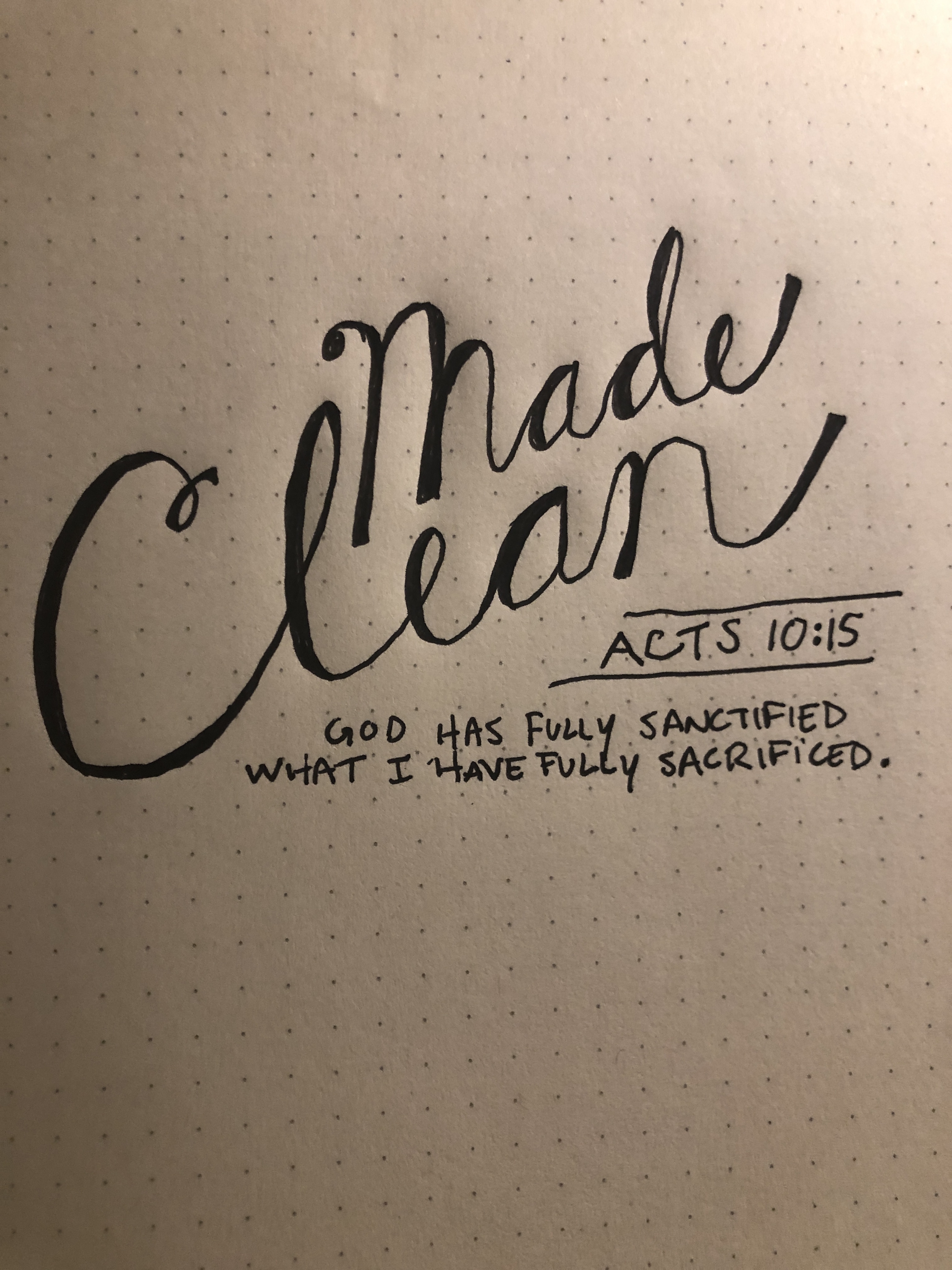
The two words that my mind got stuck on were “made clean”. Peter was essentially arguing with God and refusing to call clean what God had clearly given him. From a religious and traditional standpoint, the things contained in the vision were not clean, even though they were clearly being delivered and offered to Peter straight from God.
These two words speak to the completeness I have in Christ and because of what Jesus has done. Jesus has made me clean. Not only that, but He has qualified me to serve in His Kingdom. This is not a statement of arrogance or pride; quite the opposite. I know I am unworthy of His affection and approval. But because of Jesus’ death and resurrection, I am made clean. I am made whole. I am made fit for service.
I’ve been serving young people and their families in a full-time pastoral capacity since 1995. Even after nearly 3 decades of loving and leading the younger generation(s), I still wrestle with my own worthiness. I still have what some call “imposter syndrome”. I still wonder what I have to offer.
At the age of 16, I pushed the pile of mess that was my life across the table to Jesus and said, “Here. You can have it. If you can’t make anything of it, go ahead.” In that moment of surrender, Jesus took my meager offer and embraced me as His own. He took what I put before Him and ever since then has been working, tinkering, tweaking, adjusting, and transforming me day by day.
I hope that there’s something here that’s encouraging or at least thought-provoking to you. If there’s anything you’d be willing to share, I’d love to hear it. Put it below in the comments.
*If you know me, you know I process through doodling. Above is a doodle from today’s Lectio Divina.
For the past 8 days, I’ve been in upstate New York with a group of high school students. It’s always so amazing what happens to relationships when they’re put into that kind of context. We spent most waking (and sleeping) hours together. We saw some incredible sights (like Niagara Falls), met some incredible people (Like Sal & Mama Maria), and we were given opportunities to do some incredible things.
One of our students had an accident on Monday and long story short, I spent 2 days straight with him in a hospital room. Soon after arriving, I realized I had forgotten deodorant. Not sure if showering would even be an option for me, I really knew that deodorant would be extra important! Thankfully there was a CVS right next to the hospitial, so I walked over and found the deodorant aisle. But when I found the deodorant, I was surprised to see every deodorant under lock and key. There was a big red button (pictured here) to push if you needed help. So I pushed it. Loudly over the speakers, a recorded message declared: “Assistance is needed in the deodorant aisle! Assistance is needed in the deodorant aisle!” I gotta admit: I was a little embarrassed that now the entire store knew that I wasn’t just in need, but that I was maybe not smelling my best.
I stood there for a couple minutes, waiting. No one came. I thought about pushing it again, but one loud announcement for all to hear about my armpit needs was quite enough for me. So I headed to the front of the store to find someone to help me. I found a store worker and asked for help, so he followed me back to the locked glass case and opened it for me. As he did, he said, “You know, there’s a button right there you could have pushed.” I couldn’t help myself: “I DID!” I responded. “Oh. Sorry. I was busy.” was his reply as he walked away.
We don’t like people to know our needs because, well, then people will know our needs. And they’ll know we actually have needs. And that can only lead them to know one more thing: We’re not perfect. We humans tend to keep our needs to ourselves, thinking that we’ll be looked at differently for having needs at all. Where in the world did we get this idea? I think I know, but I’d like you to think about that for yourself.
Are you living like that store worker, too busy to hear the needs of others being announced around you? Are you too self-absorbed with your busy schedule, your laziness, or your distractedness to even be able to hear the needs around you? This week, try to be intentional in looking for and finding needs God can use you to meet in someone’s life.
In the conversations I have, hear, read about, and am surrounded by through trainings of various kinds, I can’t tell you how many times the term “post-Christian” has been used to describe American culture in 2024. And while I don’t disagree that we are, as a people, moving undoubtedly toward a reality uncoupled from religion and its vices (and faults), I do not believe we are a people who will ever be without the moorings of spirituality. So where does that leave us?
In the evangelical Church’s efforts to spread the gospel in American society over the past 70 or so years, we have accidentally instead created a structure, an institution, a set of expectations, and even a reality where some are definitely “in” and some are definitively “out”. Here’s the problem: This is all wildly divergent from what Jesus had in mind and more to the point, what He instructed His followers to be and to do. Let’s call it what it is: the biggest, most damaging “oops” in the history of the world.
If you’re someone reading this who would say that you love Jesus (most people do, actually), and if you’d say that your love for Him has radically changed your life and everything in (a vastly smaller crowd), then you might be wondering how the Church might right the ship, so to speak. How does the largest organization in the world rip itself from its status of even being an organization?
First, I believe it starts with moving away from using the term “post-Christian”, which ironically, at least in my experience, is a term only used by Christians. The term may very well be addressing the current perceived reality, but it also is a backwards-facing term. In essence, it speaks to what was more than what is. It’s a term that will keep us on the front porch, rocking slowly in our rockers, reminiscing on the “good ‘ol days”, even though how good they actually were is debatable. So, dropping the term “post-Christian” is a good first step. It isn’t serving a good purpose in any direction.
Instead, we ought to seek to understand the cultural view of Jesus. Not church, not religion, not spirituality, not faith, and not morality. To be blunt: We the people don’t know Jesus. We have a wrong view of who Jesus is. We have a concocted version that is often in stark contrast to the truth of Jesus. In other words, we have our own version of a Jesus we’ve made up, and its inaccurate. That’s not only A problem, but I believe it’s THE problem.
If you’re a follower of Jesus and you need something to label American culture with, how about the term “pre-Jesus”? Where post-Christian looks back longingly, pre-Jesus looks forward hopefully and purposefully. Pre-Jesus unhitches us from the constraints of the past; things that have taken us down rabbit-trails that have led to Christians building walls instead of bridges. The view that America is now a pre-Jesus culture gives us nothing but opportunities. Not to preach with a bullhorn, but to serve with a towel. Not to indoctrinate with a program but to influence with a purpose. Not to push an agenda but to point to a Messiah.
The fact is this: America actually DOESN’T know Jesus. And what the average person thinks they know isn’t correct, so it isn’t helpful. The foundational good news is that most Americans believe Jesus was a real person–that He actually lived here on earth. That’s incredible news and it’s where we should start. According to Barna research, every generation in recent history (last 100 years or so) has a strong belief in the historical truth that a man named Jesus (the one found in scripture) actually walked this earth. Millennials represent the lowest percentage of generational belief, but even they’re at a strong 87%. So anytime you talk to anyone, you can START with a minimum of 87% confidence that that person believes Jesus was a man in history.
What happens next to those percentages is where some of the difficulties start. While most believe that Jesus was a human, far fewer believe He was more than a human. Far fewer people are sure that Jesus was (is) God. If Jesus was only human, we can stop here and simply laud him as a good teacher and a man who did nice things before being accused and executed. End of story. If Jesus was just a man, we can rightly place him on the shelf next to Gandhi, Buddha, Lincoln, Martin Luther King, Jr., and Mother Teresa. Good people who did good things and then died.
What we must do in our pre-Jesus understanding of American culture is to correct the wrong perceptions of Jesus, paint a better picture of Jesus, and then invite people to be personally embraced and transformed by Jesus. Again, church activities have their place, but emphasizing joining a group over embracing a Savior will only lead us down the road we’ve trod for decades. Our pre-Jesus perspective opens up the doors of opportunity for those who know and love Jesus to live lives that place His nature and character on display in daily, authentic ways. Look at the life of Jesus and see how often He got dirty loving people. It was almost non-stop. Yet to many today, being a “Christian” is little more than cleaning ourselves up once a week, going to a sanctified, tidy location, and repeating a structured regiment of words and songs we’ve created largely for our own entertainment.
The pre-Jesus mindset looks at our culture with wonder and zeal to introduce America to the real Jesus. We get to reframe the common misunderstandings about Jesus and misgiving about His bride, the Church. We get to love one another well, and in doing so establish our strongest apologetic. We get to see each person as Jesus Himself sees them; worthy of His shed blood regardless of their complexion, their income, their status, their ability, their beliefs, and their habits to name a few. We get to be the very representation of the gospel of grace in the world around us.
*What I’ve shared here has been largely nothing more than my inner dialogue up until now. What are your thoughts on any of this? Do you see any differentiation between the concepts of post-Christian and pre-Jesus? Where do you see the church’s efforts falling short? Where is the gospel advancing in your life as you seek to serve others? I’d love to hear your thoughts.
(If you’d like to read more about common beliefs about Jesus, check out Barna’s research here.)
I’ve been thinking lately about systematized spiritual growth. For much of my years on earth walking with Jesus, I’d have preferred to look at our relationship as 100% organic, free-flowing, and even undefinable. After all, if what we’ve got here is a love relationship, not only can it NOT be measured; it SHOULDN’T be measured. Doesn’t seeking to apply a metric to a love affair automatically take away the cache’, the soul of it all, and the essence of what a relationship is in the first place? So I thought.
What would happen to your thoughts if I asked you to qualify your most important relationship? What would you start thinking if I required you to prove empirically that what you say you have in that relationship is what you actually have? Where would you begin? What measuring stick would you use? I believe most of us would point to our actions as qualifiers of our affections, wouldn’t we? I believe most of us would start listing the things we DO as evidence for how we FEEL. If I say to you, “I’m in love with my wife” and you reply with, “Prove it.” then I’d probably start to tell you all the things I attempt to do on the practical level; visible, outward signs that I actually AM in love with my wife. (I am, by the way.)
Can we put such measures on our spiritual health? Does action always equal affection? Of course not. But I do believe that affection always leads us to action.
I was visiting a friend in the hospital the other day. I pushed the elevator’s “up” button from the first-floor lobby and waited for the *ding* that indicated my ride had arrived. While waiting there, a young woman with a child stood nearby, presumably waiting for the same elevator. *DING* The metal doors slid open and we all stepped in. The doors slid closed. There’s that awkward, almost heavy-ish silence in elevators with strangers, right? We had several floors to ascend, so this silence would be a little bit longer than usual. Then suddenly, the silence was shattered: “WHO ARE YOU?!?” The young boy, I’m guessing 6 or 7 years old had boisterously broken that awkward silence with a straight-forward, yet equally awkward question, given the context we were in.
Always a fan of the assertive and wanting to reward him with a reply, I turned my whole body toward him to show him I was fully engaged and ready to answer his question. “My name is Jerry. I’m a pastor and I’m here to visit a teenager I know who’s here in the hospital. What’s your name?” The mom, slightly aghast of the friendly outburst her son just filled the elevator with quickly and sternly corrected him, trying to use it as a training moment on how to introduce yourself to someone. Sadly, that training went mobile as the doors opened and they walked out of that elevator. I never got my answer on who that kid was. But I could tell we’d have had a great chat, given more time.
Since then, his question has hung in my mind like an elevator between floors.
I don’t suppose he meant it existentially. I think he probably saw a man (me), didn’t know that man’s name, and very practically went about the business of finding out. Good for him. But still, the question is more than that. Much more, in fact.
Let me disappoint you here and tell you that I’m not going to unpack all there is to unpack in this one single blog post. So please revisit to travel with me on this stroll. Or as I’ve invited you previously, you can email me or text me. I’m fine with either. Here’s the thought I’m thinking and trying to move forward in terms of systematized spiritual growth and health: The life of one who embraces their own spiritual journey will ultimately travel this continuum:
“Who am I?” —————————————————————————“Here am I.”
I’d submit to you that every living and thinking human on this dust ball speck that’s hurdling at a speed of 67,000 mph through the universe is, at some point earlier than later thinking that question on some level: “Who am I?” Or to break it down a bit more, we could ask accompanying questions like, “What makes me tick?”, “What are my passions?”, “What am I about?”, “What does/should my life look like?”, “Where is my value?”, “Who are my people?”, and even “Do I like me?” All these questions and more float through our conscious and subconscious continually; until they are satisfied(ish).
The shortcut I’d like to give anyone who’d like to take it is that the question “Who am I?” cannot possibly be answered apart from acknowledging some level of Other-ness. What I mean is that you’ll never find a suitable or satisfactory answer to that question inside yourself. No offense. It’s just not possible. And here’s more bad news. If you’re someone who has spun the Wheel of Origin and landed on “Humans are accidental beings results from millions and billions of years of evolution”…well…then….I got nothing for you. But I do tip my hat on the amount of faith you’re displaying in believing that drivel. Again, no offense.
That Other-ness must–hear me–it MUST acknowledge a cause outside yourself. More to the point, it MUST acknowledge a Creator. You’ll never ever find out the answer to “Who am I?” apart from embracing that you’re not your own. If this is where you slam this website shut in disgust, then so be it.
The rest of your spiritual walk will (and should) lead you ultimately to where the prophet Isaiah ended up in chapter six of his now-famous book. Isaiah is known as the “messianic” prophet because of his mile-long list of prophecies about Jesus some 700 years or so before Jesus’ birth. Read Isaiah 6. Look at the conclusion this prophet comes to after experiencing the full majesty of the King and Creator. Knowing precisely now who he was, Isaiah rightfully came to the only conclusion any of us can reach: “Here am I.” (Isaiah 6:8). I’m not a tattoo guy, but man that verse sums up the greatest posture any human can take in terms of spiritual vitality, passion, and mission.
So I told you I don’t have all this nailed down or packaged up, but I am going to think deeply and intentionally about what it looks like to help people move from “Who am I?” to “Here am I.” After all, these two coordinates on the map of spiritual growth represent two very distinct places we find ourselves. And in full disclosure, I’ve been at both points. Currently, my daily mindset starts with “Here am I” and goes from there because I know that since I’m breathing the work isn’t done. It’s good work and it’s God’s work and that’s what I want MY life to be about. I learned at the age of 16 the answer to the question “Who am I?” and now at the age of 50, I get to live a “Here am I” life. And in case I haven’t bee clear, I fully recommend it.
As always, I love to hear from those who read my blog (Hi, Mom!). Feel free to leave a comment. And realize this one isn’t over. Not by a long shot.
“You’re one of the most patient people I’ve ever met.”
It seems to me that I’ve heard that countless times over the years. It’s often in the context of people seeing my interactions with young people and how I love and lead them, or how others have seen me teaching in the classroom. Depending on who’s making the comment, they seem to be astonished as they observe me doing what I do. To me, it doesn’t register as patience simply because my patience isn’t even being tried.
But this has got me thinking about the whole issue of patience, what it is, how you get it, and how it grows in who and why. I’ve heard people jokingly say, “Don’t ever pray for patience!”, citing that God won’t just give it to you, He’ll instead give you difficult situations that demand it, and thus grow it in you. Seems kind of cruel, if you ask me.
It might seem that some people (including myself) are simply predisposed to seeming more patient by nature. Whether that’s actually true or not I’m not sure. I don’t think it is. The whole concept of patience, I think, is largely miscategorized. I don’t see patience as something I muster or manufacture. Patience is a byproduct of a healthy outlook. When we see people as we should, patience flows more naturally. It’s when our view of others gets skewed that we begin to lose what we call patience. Imagine with me for a second if patience were a result of something rather than the thing that must be somehow summoned within you as you face adversity. Would that change your daily existence in any way? That neighbor, coworker, child, sibling, boss, or even spouse; imagine if patience for them wasn’t something you had to produce, but rather something that was already produced and ready when it’s needed?
I’ve got to downshift here for a second and address anyone who’s reading these words who is NOT in a love relationship with Jesus.
And let me clarify what I mean by that…
I’m not talking about being a church-goer. Church-goers aren’t guaranteed anything from God. Likewise, if you claim Jesus but neglect His Church, don’t expect anything from God either.
I’m not talking about just being a “spiritual” person. Spirituality will get you nowhere without a personal relationship with God through Jesus. For example, “Nature is my sanctuary” is a spiritual yet ridiculous statement when it comes to the salvation of your soul.
I’m not talking about those who have some version of faith in God that they claim but there’s virtually no difference between you and the world around you. Jesus said clearly that there’s coming a day when he will “spit you out of my mouth”.
I’m not talking about people who claim one thing but live another. Your so-called faith is nothing more than self-help, self-soothing, and even self-righteousness pretending to be something good. But you’ll find it’s going to get you nowhere but eternal separation from God’s presence.
Now, if you’re any or all of those things, but you’d honestly say you DON’T have a relationship with Jesus that is authentic, vibrant, and alive daily then I want to invite you to take a moment right now, right here on my blog site, and make the most profound and lifechanging decision any human can make. I want to invite you to put your faith in the grace Jesus showed clearly on the cross where He paid for and died for your sins. Then three days rose again, offering you His power over death so that you can live eternally with Him. This resurrection event is perhaps the most verified and historically validated event in human history. When you place your faith in Jesus to forgive you, you’re not wishing on a star, you’re putting your life in the hands of the only living God. There’s no magic words or prayer, but if you need help you can use these words as a starting point:
“Jesus, I want to thank you for loving me and taking my place on the cross. I want to confess to you that I’m a broken, dysfunctional, and helpless sinner. I confess my sins to you now and my need of a Savior. Thank you for being my Savior. I’m asking you by faith right now to forgive me of my sins and make me a new creation. Thank you for rising from the dead so that I can have eternal life starting today and lasting forever with you. Confirm in my heart, spirit, and mind that I am yours. I love you because you first loved me. In Jesus’ name, Amen.”
The first thing I’d like you to do as a new child of God and a part of His family is to share this news with someone in your life. I know that might be a scary thing, especially if you don’t know a lot of people who love and follow Jesus. I’d urge you to get into reading the Bible. Don’t start at the beginning. Read the book of Romans or read one or all of the four gospels (I’m partial to the book of John). I’d encourage you to find a church near you. Do some research and make sure that the local church you’re considering believes and teaches the Bible, believes that Jesus is the only way to have forgiveness of sins and that as Jesus’ followers, we are called to be transformed continually by the power of His own Holy Spirit working within us.
DO NOT become a part of any church that even hints at you needing to be a part of THAT church in order to be in God’s family or be saved.
DO NOT become a part of any church that adds requirements for salvation beyond placing your faith in Jesus for salvation.
DO NOT become a part of any church that doesn’t believe in one, triune God, the whole Bible as authoritative, and the call on Jesus’ followers to love God and love others with God’s love, carrying the gospel (“good news”) with them everywhere they go, and making disciples in the process.
DO NOT become a part of any church that doesn’t welcome everyone, regardless of who they are, who they love, what they believe, or what they look like. The fact is we’re all sinners in need of grace, and it’s only that grace that transforms us so regardless of the life someone may be living, God’s grace is enough to reach them, heal them, and redeem them. Let’s not forget that Jesus held up a notoriously sinful woman as an example and even said that wherever the gospel was preached, she should be mentioned (Matt. 26:13). Let’s not forget those who have been forgiven much are those who love much.
Okay, okay, back to patience. As you walk with Jesus step by step, patience is going to grow in your life. It’s not something you have to work on or practice at. The branch of an apple tree doesn’t have to produce apples. That’s not its first job. The branch’s job is to stay attached to the trunk of the tree. From that trunk and the root system, it receives all the nutrients it needs to produce apples. Jesus said, “Abide (stay) in Me, and you WILL bear much fruit. Apart from Me, you can do nothing.” (John 15) I did an exhaustive, deep-dive study into the original language on the word “nothing”. You wanna know what it means? Nothing.
What if patience grew in you like an apple grows on a healthy apple tree? What if patience (along with the other eight fruits of the Spirit guaranteed to us as we abide in Him) were simply a byproduct of a healthy, thriving, growing, authentic relationship with Jesus your Savior? What if instead of trying to cultivate patience in your life, you cultivated an intimate relationship with Jesus and let Him do the transformational work in you that He deems necessary? Does the world need more patience? Heck, yeah it does! But what it needs even more than that is people who understand that patience is a byproduct of a healthy love relationship with Jesus.
As always, I’d love to talk with you about this. Feel free to share your thoughts (even contrary thoughts!) in the comments below. If you’d rather reach out to me via text, my number is (804) 304-4669. I generally don’t answer calls from random numbers, so don’t bother calling without texting first.
“Hey Mark, take a photo of those mountains over there”, I said as I drove my rental car through Boise, Idaho. It wasn’t that I’d never seen mountains, it’s that I’d never seen THESE mountains before. Mark (who had come along as my self-appointed sidekick) obliged and here’s that photo…
I’ve been here in Nampa, ID since Sunday for an annual event called NYILC2024. That’s “Nazarene Youth International Leadership Conference”. I’m a part of a worldwide family of people whose lives are intent and focused on serving, ministering to, loving, investing in, and seeing God’s Spirit captivate, shape, and ignite the young generation of students and young adults. I’m sitting in the hotel lobby the morning after this event has ended and as is my custom, writing about what I’ve experienced will help me process and solidify some things I’ve heard. If it’s encouraging or thought-provoking to you, so much the better.
I’ll start by saying that I came into this event with a desire to connect with those specifically ministering to and among young adults. In my ministry context, we define that as 18-30 year olds. In January of 2022, “Pastor to Young Adults” was added to my role of “Pastor to Students”, a role I’ve held at Southside Church in the Richmond area of Virginia since 2004. So if you’re in middle school up to age 30ish, the lion’s share of my thoughts, wonderings, ideas, plans, and everyday breathing is revolving around you, where you are, what you’re doing, what you’re struggling with, how you’re growing, what your fears are, and how I can best encourage, support, and offer help to you, whoever you are and wherever you are.
The last two days have been cram-packed full of presentations, interactions, and conversations. If you know me, you know I’m a processor, and one of the things that helps me listen and think through my thoughts as I listen to a speaker speaking for example (but also in smaller meetings) is to doodle as I take my notes. I’m far more of a visually engaged learner so sketches and imagery are how my brain operates. I thought it might be interesting to show you some of those sketches/notes/doodles and then we can unpack them.
*I’ll also confess to you that its happens A LOT that I’m not sketching or notetaking what the speaker is saying; it often happens that a simple word they say sends my brain through a cerebral side door and I’m off thinking things that are maybe first, second, or third cousin to what the speaker is actually saying. Anyone else do that? I do it when listening to sermons, podcasts, and audiobooks too. I’ll also tell you that I hope to (need to, really) finish writing this blog in one sitting. If I don’t, my blog brain will struggle to pick it back up later. At this moment I’ve got a little less than 2 hours to finish before we have to head to the airport to fly home. So…you know….grab a drink and a seat. Or bookmark this page and come back to it, taking it in chunks. I won’t be offended.
One of the first things I experienced on day one of the conference was the chapel gathering on the campus of Northwest Nazarene University, the host of this event. We joined with NNU students in their regularly scheduled worship and teaching from the Word. This chapel’s speaker was Shane Lima, the newly appointed chaplain at another of our Nazarene schools, Eastern Nazarene College in Quincy, Massachusetts. Shane (who was also attending the conference) shared a powerful message on Matthew 10:5-7 and 11-20. One of the main things that struck me in that message was his statement, “Jesus’ presence does not guarantee the results you want.” If you’ve walked with Jesus in faith for more than 30 minutes, you’ve likely learned this through your own experience but it was helpful to hear it stated so plainly and succinctly. We all have areas in our lives that we wish were different than they are, but it’s in those moments that many of us start to wonder (let’s be honest, we doubt) whether/if God is still caring, still good, still present. But Jesus invites us to follow Him. I find in my own life that inch by inch I try and turn that invitation around to me telling Jesus, “Hey Jesus, follow ME.”….“Oh, and while you’re at it… pay the bills, give me favor in my workplace in the form of promotions that equal more money so I can buy more stuff, shut the mouth of my neighbor who’s always complaining to me about something, help that person at that intersection who’s holding that cardboard so they won’t stand there anymore because they make me uncomfortable, fix my spouse so they’ll see things my way, open up doors of opportunity for me so I can enjoy life more, don’t forget those bills, and heal every person I know who has an illness because why wouldn’t you?” I’m not sure if anyone else is inviting Jesus to follow them instead of starting each day with a surrendered mind and heart so that I can follow Him, but that’s my struggle.
After chapel, we came back to the main session area and settled in for some information and learning. One of the presenters shared a statistic about teenagers as an encouragement to us as leaders who impact young people. But I couldn’t help but fixate on a stat they didn’t focus on or even point out. Take a look:
The emphasis was placed on that 56% in the middle there. 56% of teenagers agree with the statement “My generation can make a positive impact on the world.” So naturally the win here is that most teens still have a positive view of their ability to affect change. That’s great. But do you see what I saw? A 17-18 year-old senior in high school might think they can make a positive impact on the world but look at where we can reasonably estimate a 20-year-old young adult is in their view. What happens in a matter of sometimes a year or two that causes that percentage to drop nearly TWENTY percentage points?!? What is going on with young adults that there is such a shift away from a positive perspective about their ability to impact the world? So many questions flood my mind about that. If you’re in the age range of 18-30, would you reach out to me and share your thoughts with me on this? My email is jvarner@southsidechurchva.org or if you’d rather stay anonymous, text (804) 464-7077. If you text that number, I won’t know who you are unless you tell me; it’s completely (and intentionally) anonymous. That moment in that presentation when I saw those numbers really triggered a lot of thoughts I want to digest and process. (And I’m not a dude who’s a sucker for stats, either. Nor do I think “the sky is falling” the way it seems most stats are designed to make you feel.)
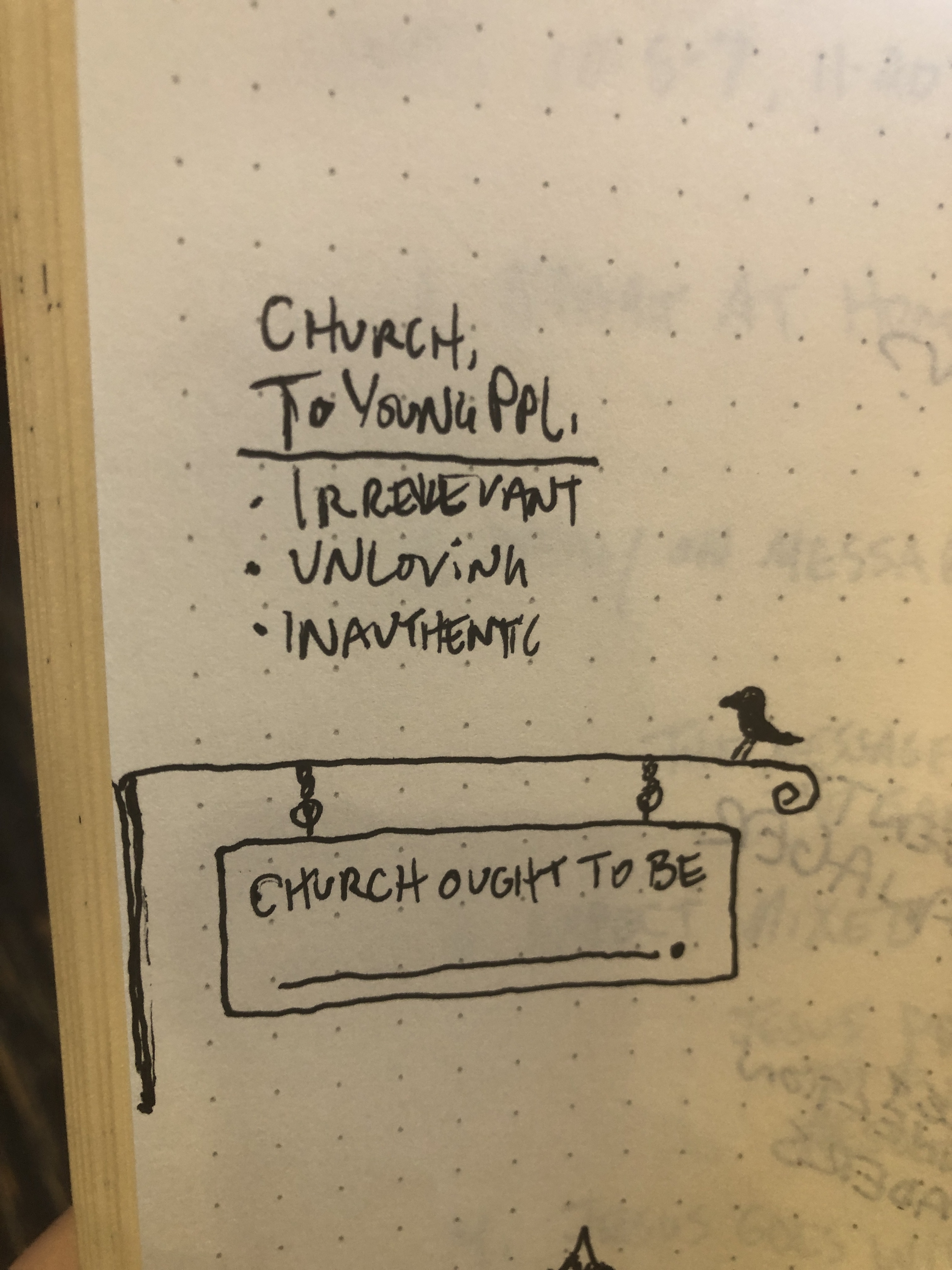
Okay, on to something else I jotted down. The presenter was telling us that according to studies, young people describe church as “irrelevant, unloving, and inauthentic.” I’m going to be gut-level honest here. My first thought was “Well, if they came to MY church or the ministry that I lead, they wouldn’t think that.” But you know what? I can’t remember the last time I even asked the teenagers I interact with week in and week out how they view our church family/spiritual community. Would they say the same thing? Man, I hope not. But I can’t dismiss this just because I want to disagree with it. Reality doesn’t work like that. So I think maybe I’ll ask as many young people as I can to give me the adjectives they’d apply to church. And/or maybe fill in that blank I’ve doodled on that sign hanging over there.
Church. You know who are you. I’m talking to you, Church. If you claim to love Jesus then LOVE JESUS with all you are, all your priorities, all your affection, in all the areas of your life. Be transparent, be vulnerable, be grace-filled, be connective, be authentic, be willing to embrace others in the name of Jesus. If you don’t then the young generation will continue to find the Church irrelevant, unloving, and inauthentic. Ask yourself this question: What am I doing to connect with younger people in my local church and community? It’s often only a matter of smiling, greeting them warmly, offering a hug and a listening ear, inviting them into conversation, and being real. Today’s young generation doesn’t need perfection. They need people who are willing to link arms with them as we walk imperfectly with Jesus. So if you’re clocking in on Sunday mornings and clocking out at noon on Sunday then please have a conversation with God about what’s causing you to do that. It’s not hyperbole to say that a generation hangs in the balance.
As I thought my rabbit trail thoughts in that conference seating, I thought about that bucket of Hot Wheels and Matchbox cars I loved to play with as a kid. I had some tracks I’d attach together and somehow got my hands on one of those special pieces of track that has these dense foam wheels that spin and propel the racecar forward and further down the track. That racecar can go on perpetually if there are enough of those special pieces of track for that car to reach. What if we as adults in the lives of young people committed to propel them forward in their faith, in their relationships, in their interests, in their questions, and in their search for the purpose of their lives? Based on current research, not only are most faith communities NOT propelling young people, but they’re actually repelling young people. We’ve got to turn this around, but this isn’t the job of Young Adult pastors like me. This has to be a Church culture thing. There has to be a shift away from holding on to what was for our own comfort’s sake and a willingness to venture into what could be for the sake of the souls of this young generation.
Related to this is the keychain concept. The Church has for a long time treated 13-18-year-olds as “wait your turn” not-quite-ready-yet addendums. Many churches even use the term “Next Gen Pastor” which I feel is an inadvertent slight to the generation we’re seeking to serve. Isn’t “next” essentially “not yet”? No, we’ve got to enfold young people into the Kingdom life of the local church on every level right now. One church I learned about dismissed its adult prayer team that prays with people at the altar during response time of their church services and replaced it with a prayer team made up of teenagers. Nice thought, but that’s not what I think should happen. We need young people linking arms and being valued by the Church. Students should serve in any area where adults are being trusted, with a caring and supportive partnership where there truly is a discipling that happens. If we treat students like “wait your turn” then we shouldn’t be surprised when they view themselves as not good enough and never ready to offer who they are and all they can to the Kingdom. To put it bluntly, they get tired of waiting and simply leave. Because quite honestly, that’s the message they’ve received from us.
I’ll say here as loudly as I can that I’m proud to be a part of a church that places a heavy emphasis on ministering with (not just to) young people. I am living, and breathing proof that this local church I serve prioritizes inclusivity of the young generation. The focus here is to disciple lifelong followers of Jesus, not just weekly church attenders. I’m not interested in giving young people more things for their calendars, or simply a place to be. It’s far more about heart transformation. That’s why starting on Easter Sunday and each Sunday thereafter, students will be engaged in worship shoulder-to-shoulder with the adults of our church. Our students need to see what 70-year-old worship and surrender looks like and our 70-year-olds need to see what 15-year-old surrender and worship looks like.
I’m continually giving the keys to young people. I’m disinterested in building a Jerry-centered kingdom where all things hinge on me as a pastor. While I’m away in Idaho, our Young Adult Community group carried on without me, as does our student Grow Groups gathering tonight. If this ministry is based on what Jerry does, we’re screwed. That’s why we must continually hand the keys over to young(er) people.
Kara Powell, Executive Director of Fuller Youth Institute was with us for this conference. Kara and her team are a tour de force in the area of researching youth culture in America and resourcing leaders with the tools they need to effectively impact this young generation. The work Fuller Youth Institute (FYI) does can’t be overstated. If you have a heart for young people, you likely already know about Fuller and Kara Powell and it was great to hear from her this week.
Kara and the Fuller team have written so many books and material centered around the three areas that young people grapple with; the 3 questions that need to be answered if they’re to have a healthy understanding of themselves and their place in this world. The 3 words are: Identity, Belonging, & Purpose. And the 3 corresponding questions are: “Who am I?”, “Where do I fit?”, and “What difference can I make?” Truth be told, there are plenty of adults that still have a slow-simmering of these questions in their minds because they’ve never addressed them intentionally in their younger years.
In true rabbit-trail fashion, I added to these three words three other words that I felt were reflective of the process that young people go through in terms of finding their identity, their place of belonging, and their purpose. Those words are: Acceptance, Affection, and Action.
Acceptance: I’ve said it countless times to parents of young people: Whoever offers your son/daughter the most acceptance and affirmation will win their affection, so make sure that’s you! When a teenager feels acceptance, this speaks directly to their identity and their sense of belonging. I’ve seen it and so have you–a young person goes through a metamorphosis and begins to dress and speak like the group of friends who have shown them acceptance.
Affection: Hey Dads, can we talk? Studies show that on average us dads stop showing affection to our kids (especially our daughters) around the age of them reaching 13 or so. This has proven to be disastrous. Parents, please say “I love you” until they roll their eyes. Say “You can talk to me about anything” as often as you possibly can. Don’t stop saying it. Say it out of the blue, say it in the car, say it over their shoulder while they’re doing homework, say it when you notice them in a sullen mood. Say it when they’re elated over some triumph they’ve experienced. Say it over and over.
Action: This young generation is filled with activators. Its human nature to respond to causes, but in our age there is a continual torrent of causes to act on. Action is hardwired into the DNA of this young generation. When we present to them a theoretical faith that has no clear outplay leading them to outcomes and greater spiritual intimacy, they quickly lose interest and rightfully so. Ask the question “What does this truth compel me to do?” anytime you read God’s Word, or share wisdom with a young person. They’re built to act. We as the Church sometimes focus more on information than transformation. Of course, information is essential. But if we’re simply feeding information and not leading transformation, we’ll lose them.
This next bit of information was sobering but maybe comes (for me) a bit too late. My wife and I have 4 kids, and the youngest one is 20 years old. So if you’re a parent of a 0-18 year old, just look at that number: 91%. 91% of the time you’ll spend with that human will happen before they turn 18. The other 9-10% will be spread out over the next 40 years.
Still think you can put off intentionally doing the things you really want go but somehow can’t get around to? Let me suggest a few things:
Tell them you’re here for them no matter what.
Tell them you’re proud of them without attaching it to some task they accomplished.
Tell them you can’t believe God is letting you be their parent.
Tell them you are the #1 supporter of their dreams, without qualifying your like/dislike of those dreams. Share your story with them about how God has directed your steps.
Spend the time you really need to spend with them in conversation, rather than thinking they wouldn’t want that (Statistics consistently show that parents are far and away the #1 influence in their kids’ lives).
Let your faith be visible for them; not to be showy but to show them that its real in your life.
Let me wrap this up with one final truth that stuck out to me as NYILC came to a close. Shane Lima once again shared from God’s Word and was preaching from and around Jeremiah 29:11. It’s a well-known verse that many people claim for themselves, especially in times of uncertainty or when they’re thinking about the future. Many young people who hear this verse use it as a remedy to what might otherwise be a tailspin of anxiety when they think about all the question marks in their life.
This one hits closer to home because this very verse was painted on the bedroom wall of our daughters’ bedroom. Every day, and as they slept this verse literally hung over them:
“For I know the plans I have for you, declares the Lord, plans to prosper you and not to harm you, plans to give you hope and a future.”
When we read, study, teach, or preach God’s Word, context is king. I’d suggest that you read for yourself what the context of this verse is. Read the entire chapter. Today’s parents and young people aren’t wrong to claim it or lean on it in times of uncertainty, but there’s a bigger picture here. For now, I’d like to point out the “I” in this verse. I was struck by the fact that it’s God who knows and He is “I” that matters. Often times I get wrapped up in deciphering the plans or getting wrapped up in the details of what’s now and what’s next. That’s not necessarily wrong until I place knowing details on the same level as knowing God. Flying home to Richmond from Boise demands that I literally place my life and all my trust in a pilot that I’ll never meet and don’t know. What I do know is that he’s qualified and capable of directing that plane across this enormous country and landing it on a thin strip of asphalt, right on schedule. If I can place that level of trust in a pilot I’ve never met, I can surely place my life in the hands of a God that I have met, and do know.
All in all, NYILC2024 was a time of connecting, refreshing, and reminding. I love the opportunity to connect with others who are living life loving young people like I am. I love the refreshment that God’s Spirit gave me through those couple of days away. I wouldn’t call the conference restful, but it was certainly refreshing. The reminders that God desired me to hear came in the form of one-on-one conversations, collective worship, receiving helpful information, and giving me ample opportunities to find a tremendous joy in seeking to encourage those around me.
*As a fun surprise, a blog post I wrote for NYI Connect went live during NYILC2024. If you’d like to read that blog post, you can find it here.
Here’s a shot of one spread of my notebook that has some other stuff on it that I didn’t write about here…









 jerrythinks.