I had the privilege to speak to a group of teens at the annual Rockfish Youth Conference recently. We had a wonderful time under this year’s theme: “Rooted”.
(The video has subtitles, and I hope to also upload an audio-only version.)
If this message is an encouragement to you, please feel free to share it, and if you’d like to talk about me speaking at your event, just click on the “Speaking At Your Event” tab. Thanks!
You’ve likely heard the twenty-third psalm at some point in your life. Probably at a funeral. For some reason, it’s one of the greatest hits at funerals. Probably because it has the words “…valley of the shadow of death…” so we figure a funeral is a good place to put it.
It’s not that that’s not appropriate or true, but to relegate this powerful chapter to a spot at the end of life really does miss the point of what the psalmist is saying (singing) throughout this amazing chapter. And today I want to center in an often-overlooked and beautiful truth found tucked in the lines of these verses.
Here’s all of verse 4 of Psalm 23 (read the whole chapter sometime):
“Even though I walk through the darkest valley, I will fear no evil, for you are with me; your rod and your staff, they comfort me.”
David (the author) was a shepherd himself, so he was well acquainted with the usefulness of the shepherd’s staff. A shepherd without a staff was…well…a ridiculous thought. Shepherds needed a staff like a baker needs a bowl, a policeman needs a pistol, a plumber needs a wrench, or a seamstress needs a needle. Absolutely essential.
But what you may not know is that the shepherd’s staff was used in two different ways. In order to understand this, we simply need to think about the love of the shepherd for the sheep of his flock.
Let’s look again at this line in verse 4: “your rod and your staff, they comfort me.”
So what is the shepherd carrying? Is it a rod, or is it a staff? The answer is yes. The stick the shepherd carried played two important roles: to protect and to correct. And so it is with the Good Shepherd. And so it is with God’s shepherding heart toward you right now.
The staff that a shepherd carried was used to protect his flock from predators. The length of the staff was useful in warding off whatever came the way of the flock. The shepherd would poke, swing, jab, and possibly even throw–whatever needed to be done to keep the enemy of the flock from having any way to get near to them.
Right now, in the heavenly realm, God the shepherd is warding off the attacks of the enemy. You, at times, might catch a glimpse of these protective movements, but I’d dare say that most of them are invisible to you and me. David’s acknowledgement of how God protects him ought to be a point at which we also acknowledge that God is at work in our lives, too. The business end of that staff is thwarting the attacks of your enemy on your behalf. The “rod” part of the staff was what we would normally understand as the end lowest to the ground; that end that touches the ground and would be nearest to any danger.
The other end of the staff was what we normally think of as the “crook” or the “hook”. It was very common for shepherd staff to have this bend in them for the sake of placing around the neck of a wayward sheep that starts to wander while the flock is moving along. It might also be used when a flock is feeding on a grassy place and a sheep isn’t paying much attention to the fact that they’re wandering off and into dangerous places. At those times, the shepherd’s hook was useful in corralling a sheep back in the direction of security. This would be the end of the stick that we’d imagine was closer to the shepherd’s head and shoulders, always ready for deployment in the direction of a sheep who’s headed into a direction different than what the shepherd desires.
So, sheep….what abaaaht you? (Sorry, I couldn’t resist.) Where do you see God’s protection in your life? Where do you see God’s desire for correction in your life? Can you recognize that God is working on your behalf to only allow into your life what would bring Him glory and what would ultimately be for your good growth? Can you recognize that God is lovingly corralling your heart toward His? Can you hear and recognize the voice of our Shepherd? Jesus Himself told us that those who know Him know, recognize, and follow His voice. Are you listening? Are you wandering? Are you pulling away? Are you trusting?
I’d love to hear your thoughts about this shepherd’s stick God carries for our good. Feel free to comment or reach out via email. As always, I’m grateful for anyone/everyone who takes the time to read these posts.
Anyone who believes anything also doubts. Doubt is just a part of the package in this human experience. In terms of spiritual health, doubt plays a rather important part in helping growth and maturity happen. That’s what I want to kick around with you this time.
Doubt in your life had a genesis, a starting point…so where would you say it began? As we grow into pre-adolescence, our adolescent years, our young adulthood, and then into our older adult selves, doubt comes along for the ride.
The developmental process of the brain invariably impacts spiritual processing. It can’t not. As we learn and as our synnapses make stronger connections and forge new paths in our brain, we wrestle and struggle with things that we perhaps once held as absolute truth. Expressions like “What if…”, “I wonder…” and “Maybe not…” are peppered into our once-confirmed ideas of truth and reality.
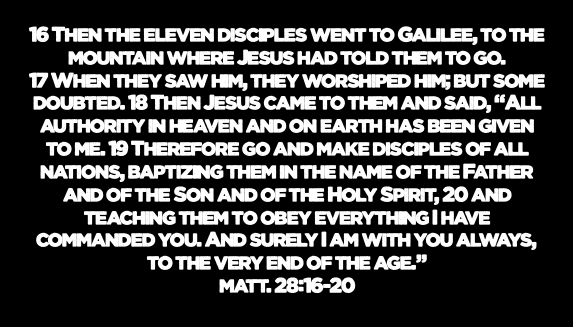
What I’d like to do is to lay out a few of the places where we see doubt play a part in the Gospel story. And believe me, it definitely does. Let me take you first to the Mount of Olives where Jesus met with his disciples for the very last time before ascending into the clouds.
Read that again. Notice verse 17. We’re told, “They worshiped Him; but some doubted.” Hold up. This is the now risen Jesus. This is the man they have watched for three years, day in and day out. This is the man who they all saw walk on water. They watched Him raise people from the dead. They carried the baskets of leftovers from the miraculous feeding of the 5,000 men (and then another 4,000 soon after). This is the man they heard night and day teaching with “power and authority”. This is their Rabbi that they heard predict His own death on a cross, watched (and ran away from) His arrest, and saw Him being nailed to a Roman cross of crucifixion. This is the man they’ve spend forty or so days with post-resurrection. What do you mean “but some doubted”?!?
But that’s not even the most interesting part. What is astounding to me is that Jesus went full speed ahead on commissioning this group of disciples to carry out what we now refer to as “The Great Commission” found in Matt. 28:19-20. What I’m pointing out is that Jesus handed over the carrying on of His Kingdom on earth to a mixed-bag group of believers AND doubters. He could have (and maybe should have) said, “I’m not going anywhere until you can all prove to me that this Gospel is deeply rooted in your heart; that there’s not one shred of doubt within any of you, because the mission–MY MISSION–is far too important to just leave to a bunch of people who are still wondering if I’m the Son of God or not.”
So if you’re struggling with doubt, or ever have, you’re in the best company. The very disciples who Jesus spoke with face-to-face also wrestled with their own doubts. And yet, here we are. Anyone who claims to follow Jesus today can trace their spiritual lineage to one of those disciples on that mountain, staring up into the clouds while the man some of them doubted was God literally ascended into the sky.
Let’s look at another example of doubt in the Gospels and what we can learn…
I won’t launch into a deep-dive exegesis of this passage as I have done in the past. I’ll just point you to this particular verse that comes at the end of the account where we’re told about Jesus’ very first public miracle–one that he was actually completely reluctant to perform. But alas, Mary gave us the very first historical record we have of a Mom pulling the “Mom Card”. We find verse 11 at the tail end of this passage about this wedding in Cana. Notice what it says: “And his disciples believed in Him.”
What were they doing before the water-to-wine miracle? Can we rightly infer that there was less than “belief” in Jesus before that first miracle? It seems they were still kind of “kicking the tires” of this alleged Messiah before that point. Seems like perhaps some of them were not completely sold out in terms of their faith in Jesus.
Okay, one more…
I think Thomas gets way too much heat for this statement. Let’s be real. Dude was only saying what everyone else was thinking. You probably have a friend like that. And what you like about that friend is that you never have to guess where they stand on stuff. Thomas was adamant about his faith. He wasn’t just gonna roll over and put faith where facts go. Nah man, nah. Not Thomas.
But look at where “Doubting Thomas” ended up. Some 3,000 miles away from that mountain where Jesus left him, we find Thomas carrying the Gospel message to the people of India and Turkey, and eventually we find Thomas meeting the end of a spear as a martyr for the Gospel message and the very Jesus that he insisted on seeing for himself. Thomas grew into full faith because he was willing to be real about his doubts.
So even if you’ve got doubt in your story, you’ve got usefulness in God’s story.
Doubts play a redemptive role in our faith. Doubts give us the opportunity to have our convictions tested and proven. Doubts indicate places where we can dig in, ask questions, and find that Jesus really is who He said He was all along. Don’t downplay doubts. Doubts aren’t the enemy of faith, but they can be the paralyzer of growth if left unexplored. Let your doubts show you where to dig next.



 jerrythinks.