Freedom From The Press

I’ll admit it. Sometimes I get so focused on what appears to be urgent that I neglect what’s actually important.

Believe it or not, I find this (and any) time at the keyboard of my blog to be a type of therapeutic exercise. The thoughts form as I think them. I usually do–like today–come in with some concept, but as I begin to type, more, new, different thoughts flow, and my fingertips turn into a spout of sorts, letting out what’s going on within.

Sounds a little like therapy, right? I’m grateful for opportunities to meet you, myself, and sometimes even God in these moments, simply typing.

What I’m NOT saying is that posting on this blog is what’s important in my life, let alone the MOST important thing I could be doing. (A quick break to recognize my subscribers–Hi Mom! I’m so thankful for you!) But I do think it is a fairly accurate and good example of what gets neglected when the urgent notices pile up in my brain, on my desk, and on my calendar.

This morning, I sense God’s Spirit saying something to me that He has said many times before. Something I am still learning how to live out, and something that aligns with how God operates in my life. When I receive this message in my mind and allow it to creep the 12 inches to my heart, really good and healing things happen. God also uses His message to me as a clarion call; a type of caution flag that I’m getting dangerously close to the temptation of feeling overwhelmed with–well–life, and all the things that clamor for my attention, emotion, resolution, action, energy, and/or anxiety.

So today, I’m easing into the day with a bit more mindfulness that there is most assuredly a difference between urgent and important, even as urgent masquerades as important.

I’m not sure what triggered it, but last night I was reminded that I don’t think that I think like other people think. That’s a dumbly obvious statement anyway–I mean, who does? You’re you and I’m me and I don’t expect us to operate the same way. But there seems to be a piece of adulting that I feel I missed out on. There’s some ability, or insight, or know-how that those around me seem to swim in and carry out effortlessly, while I’m usually looking for some clue as to how they got there.

I know, I know. It sounds like I’m comparing myself to others and I’ve preached loud and long that the comparison game has no winners and never results in any good outcome. But still. I think this is related to the whole urgent/important thing.

I can’t (so I won’t) put a stiff finger on the issue. I think it’s a little too fluid and fluctuating to nail it down like that. I also know that the #1 step in solving a problem is to call it a problem. While some might say, “Of course it’s a problem! You’re not firing on all cylinders! Fix it immediately!”, I guess I’d rather bat it around a little first. What might be hastily labeled a problem might more accurately and helpfully be considered an intricacy or a nuance.

Some of what I’m referring to can be summed up in the word “process.” That is, how my brain (and yours) processes information, puts it in its proper place cerebrally, integrates it in a way that is useful/practical, and leverages it for future action.

In my imagination, I do this differently than you do. And that imagination also indicts my process as “lesser.” So get this: because I convince myself that my processor works differently than yours, my mind automatically assumes that it works worse than yours.

“Hello darkness, my old friend.”

So what I’m constantly doing is creating outside frameworks that supplement my thinking in order to prop up a sense of on-top-of-it-ness. In other words, my organizational approach to time, tasks, and thought is almost always undergoing renovation and improvement. Or maybe just renovation. Have you ever been in a renovation project that never seems to reach its conclusion?

I think maybe renovation isn’t the right word here. Maybe tinkering would be a better fit. The problem is that I’m a renovator. There is something within me, no matter what the context, that is always seeking improvement. In any room I walk into, my mind immediately reconfigures the furniture so as to reach a higher level of aesthetics and functionality. When I listen in on meetings and ideas being thrown around, I’m engaged in sculpting those thoughts so that they reach their highest caliber. Even when something is established, I’m constantly questioning how it can be even better.

So it exacerbates the levels of frustration when my brain, which seems so intent on improvements, can’t also seem to get a process that works in tandem and cooperation with how it naturally functions. Woe is me.

That’s why, I suppose, I’m always striving and yet never arriving. Even now, I’ve got this blog page on one screen and inches away on another screen is a “project_task_tracker”; my latest iterative attempt at thinking, sorting, and executing…thinking, sorting, and executing…thinking, sorting….

You get it. (Or at least my brain is hopeful that at least one person can sympathize with some shred of something here.)

Okay, so back to the title of this particular blog post. What happens to me when I’m unable to effectively sort and execute is that the urgent presses in and convinces me it’s the important. So, what I’m seeking through organic and organized thought and processing is freedom from that press.

So, with today’s therapeutic typing session coming to a close, I’ll head back into the fray. I’ll continue to think, wonder, imagine, dream, question… then, with any available answers, I’ll start to shape thoughts, identify obstacles, exploit opportunities… then with those options, I’ll choose what becomes a decision, a plan, and a path for today. Then I’ll do it again tomorrow.

See you then.

So, I went back and read my blog (as is my habit before clicking “Publish.”)…

The fact that, as a pastor, I didn’t include even one chapter and verse from scripture might seem to some as a big miss. So my mind went right to imagining who might be disappointed in my ommision of God’s Word in this post. Insecurity and inferiority creep in so easily sometimes. But rest assured, dear readers, that God is near and He is speaking, and I am attuned to His voice. I know what His Word has said and is saying today.

Related to that, I will also exclaim that Jesus Christ, God incarnate, is the only solid ground this feeble mind has found. So I offer that to you as a testimony. If you haven’t found that to be true, may I invite you to try Him? Taste and see that the Lord is good.

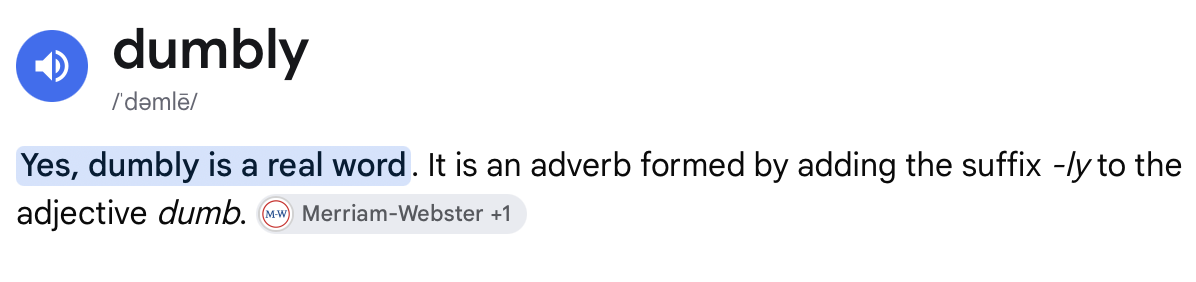
Also, in case you tripped over my use of “dumbly”, I humbly submit…
On Confidence

I sometimes wonder what percentage of the average adult’s insides are occupied by the child version of themselves. On the outside, we appear to be put together, mature, doing just fine, and ready to tackle whatever the day holds. But what part of you is still underprepared, timid, or unsure of what next step is the right next step?

The quality of confidence is a magnetic one to be sure. But if it’s true that many adults walking around today are toting their own childlike version of themselves along with its insecurities, how much of confidence in day-to-day life needs to be feigned in order to operate as a “normal” adult? This is what I’m wondering today.

As I look back on my own life, I can absolutely see a growth path that has afforded me to move more into a place of competence, if not confidence. As a side thought, I think confidence and the concept of being a confident person can have it’s own baggage. There seems to sometimes be a thin line between confidence and cockiness or even outright arrogance. Arrogance is repulsive, while confidence is attractive. So it’s important to be careful about what side of that thin line you are on.

As a spiritual exercise, it’s also important to consider what (if any) role confidence plays in the life of a follower of Jesus. Certainly there are reasons to have confidence, and these are supported with scripture. However, confidence as the world defines it has far less of a place in the heart, mind, and attitude of anyone who claims to follow Jesus.

Is there such a thing as holy, sanctified, or pure confidence? I think there is.

Let’s look at a few examples that tell us exactly where our confidence should be:

  • Proverbs 3:26: “For the Lord will be your confidence and will keep your foot from being caught.”
  • 2 Corinthians 3:4-5: “Such confidence we have through Christ before God. Not that we are competent in ourselves…but our competence comes from God.”
  • Isaiah 41:10: “Do not fear, for I am with you…I will strengthen you and help you.”

The flipside of the coin is where we are warned about the places NOT to put confidence:

  • Philippians 3:3-4: “…we who serve God by His Spirit…put no confidence in the flesh–though I myself have reasons for such confidence…”
  • Proverbs 28:26: “Those who trust in themselves are fools…”
  • 1 Corinthians 10:12: “If you think you are standing firm, be careful that you don’t fall!”

So as you move throughout your day, it’s good to know who you are, what you’re about, what things you’re good (and not so good) at. This helps you function among others in a way that is cooperative and helpful. But be careful not to think that your personality, skills, abilities, and connections are more valuable than another person’s. This is where the line gets crossed. This is where people move into arrogance, and this is where patience and compassion die, and where humilty breathes its last breath.

How to build the right kind of confidence:

  • Begin with a conversation with God each morning. Let Him set the thermostat of your confidence. In Him you are completely loved, accepted, and usable for His glory all throughout your day. So each morning, you get to choose if you’ll be submitted to Him or go it on your own.
  • Be honest in your reflections on the skills you are blessed with. Seek ways to hone them, sharpen them, and exercise them. A dream life might be where you get to only do what you’re good at every day all day, but that’s not reality for 99.99% of us. So look at your hour-by-hour movements as filled with opportunities to not only grow in what you love, but explore and improve in what you’re not quite as good at. Some very qualified people have suggested that you jettison what you’re not good at, and only allow yourself to live in the lane of your own skills. But I think that approach forfeits skill expansion.
  • Exploit any chance you get to share what you know with others, especially those who are behind you on the road you’re on. You’re not the first to do what you do and you won’t be the last. Good stewardship of your confidence means that you must share what you have with those who will be strengthened by it. Take any chance, big or small, to invest your knowledge in people who will likewise steward it well and benefit from it. If you’ve been doing something (anything) for more than 2-3 years, you absolutely have plenty to offer those coming behind you. Be the kind of confident person who doesn’t gatekeep the lessons you’ve learned.

These are just the beginnings of some developing thoughts on confidence that I’ve had recently. I want to invite you to share your experiences with me. Leave a story, a truth, or anything else in the comments that have to do with confidence and the role it plays in our daily lives.

From Derailed to Rerailed

Lately, I’ve been a wee bit obsessed with finding a new old train for this year’s Christmas tree. I’ve got in my head the vision of having a vintage yet functional electric train choo-choo-ing its way around and around and through the gifts under the tree this year.

As a child, I had a trainset that was given to me from a friend of my parents. A man named Merrill that I have zero recollection of. I remember his name only because its written (presumably in his own handwriting) in faded black marker on the box that contains all the train pieces that I currently have in our closet. By the way, when I open that box, it smells like my childhood. (Isn’t it weird how smells connect us to memories? What smells triggers memories for you?)

Anyway, of all the pieces of track I’ve had in my possession, one of my favorite pieces is the rerailer track. If you’ve ever seen a model train running, you may not have even ever noticed it among the other pieces. It’s typically disguised in a railroad crossing. It’s a critical piece of any set, and it’s what I want to talk to you about briefly today.

We’re likely all familar with the term “derailed”. It’s an ominous word that almost always indicates something has gone wrong. A project gets derailed, a relationship gets derailed, a business deal gets derailed, or in any other way, forward motion hits derailment and things are severely hindered.

Is there any derailment in your life right now? What has gone awry? What isn’t sitting as squarely as you’d like? What remains not just undone but unhealthy? When a model train derails, its obvious. It’s noisy. It’s bumpy. Likewise, when I ask you “Is there any derailment in your life?” you don’t have to guess. You know. It’s noisy. It’s bumpy. It’s obvious.

The bigger question then is where is your rerailer? What does (will) it take to get those wheels back on track? What resets your mind, your attention, your priorities, your heart on what’s healthiest, most important, and most effective in the mission of your life and who you are?

Come back another time for my personal list of rerailers, the things that always get me mind and heart back to where they should be. But for now, what works for you? Use the comment section below, send me an email, or shoot me a text.

Putting the “me” in “mess”

It was the final frame of the 2012 U.S. Open Bowling Championship in my childhood home state of New Jersey. Bowling legend Pete Weber was poised to clinch his 5th championship title, and a strike here would crown him bowling king once again, by a one-pin margin. Weber slipped three of his fingers into the holes of his perfectly weighted, balanced, and shined bowling ball. All during the championship, and as he made his approach on this historic frame that would decide the outcome of the tournament, Pete Weber had in his mind (and ears) a young heckler (unidentified to this day) who jeered at him. Unphased, Pete Weber maintained his steely focus on the 10 pins at the end of that finely oiled lane; pins that were doing their own heckling of Pete Weber.

Moments later, Pete Weber celebrated a perfect strike and, in exuberant celebration, gave the sporting world one of the greatest, most bizarre, most perfect-fitting exclamations of victory ever to be uttered:

“WHO DO YOU THINK YOU ARE? I AM!”

It’s a messy, awkward, nonsensical declaration that somehow fit the personality of Pete Weber and the alpha-male moment perfectly. But still…it was just…odd.

I appreciate how AI took this statement of Weber’s and straightens things out with a more logical explanation:

“Who do you think you are?” Implies that the person believes they are bigger than what they are. It elicits the thought of a powerful person. “I am” confirms that I am, in fact, who you think you are.

What’s the moral to this story, and why am I telling you about it? It’s because it’s the perfect reminder that people are messy. If you’re going to interact with other people, you’re going to get mess on your hands. It’s not a matter of if, but when. And when is always either “now” or “very very soon.”

I remember the moment in my life when I realized that people are messy. I don’t think I’ve ever shared this story with anyone. Somehow, this morning it slipped back into my consciousness, and with it, a trickling of some childhood emotions.

In elementary school (sixth grade, I think, which in those days was still elementary school), I had a really good classmate and friend named Jeff. We played trumpets together in the elementary school band, and we just got along really well. We were always joking around, laughing, and making the best of our school day. Jeff had become a good, positive, pleasant, and fun part of my school day as a young boy. We didn’t do much together outside of our school day, but when we were there together, it was always a good time.

Then one day I happened to see Jeff at a small shopping plaza–the Acme shopping plaza, I believe–in the little town of North Cape May, New Jersey, where I grew up. When I saw Jeff in that context, he wasn’t the Jeff I knew from school. He wasn’t smiling or even friendly. In fact, he was aggressive. He seemed angry. And in a matter of moments, became violent. I recall him pushing me, as if to invoke some kind of fighting response from me. I had no training either in self-defense or even about what to do in such a situation. He kept pushing me as I kept trying to get away from him.

This is part of the front of that old Acme shopping plaza, now vacant.

My young mind was racing, confused, and frightened at what was happening to me in that moment, in broad daylight on the cement walkway that ran along the front of that shopping plaza. What had I done wrong? Nothing I could think of. Why was Jeff acting this way? I had no earthly idea. I simply wanted to get away from this person, whom until that moment I had considered a good friend.

I understood in that moment for the first time, that people aren’t always easy to understand. That people aren’t always going to do what you expect or think they should. That, in short, people are messy.

My time in ministry for over three decades now has only served to support this truth. I know that anytime we’re interacting with others, we can count on it statistically that a mess is going to emerge. There’ll be some miscommunication, some misunderstanding, or even some perceived hurtful thing that happens or gets said. If you don’t believe me or agree, you’ve likely never had a conversation with anyone at any time about anything. For those of you who have, you’re nodding your head in agreement.

One of the most critical components of mess management, however, begins with the first two letters of “mess”: me. I should never have as my default setting the idea that when a mess arises, it certainly can’t be because of me. A healthy stance to take when interacting with any mess is to ask questions like, “What part do I have in this?” or even “What have I done–even inadvertently–that has contributed to the mess at hand?” Simply put: “What ownership do I need to take when it comes to the current mess?”

Here’s what that kind of honest vulnerability will do:

  1. It will make you humble and approachable, two qualities that do what nothing else can.
  2. It will disarm and diffuse the tendency for blame-laying over responsibility-taking.
  3. It will level the field in terms of anyone involved, allowing everyone to work together.
  4. It focuses energy on solutions rather than causes. (Not that fact-finding isn’t important.)
  5. It creates malleability instead of rigidity. Being malleable is a key ingredient to resolving messes.

So the next time you encounter a mess, don’t do anything before you remember the “me” in the mess.

Before shoving someone down a cement walkway, take stock of where the “me” in the mess is. When you do, reach out to me and tell me what transpired and what you learned from it.


Case in point: This morning, I have on my mind a situation that just happened this past weekend. I had an understanding of something that I thought was clearly planned and settled, and yet someone else had a different version of reality. At a certain point, those two perceptions of reality–mine and theirs–collided and made a small mess. Thankfully, it was easily rectified and we moved forward, but I had to do the work of mentally reviewing the situation, and thinking intentionally about my part in what had transpired.

I was tempted to dig in my heels, doubling down on my version of what was supposed to happen, but when faced with a different version, I chose instead to believe the best in the other person and give way to a different route. Then in quick hindsight, revisit the situation to see what can be learned and strengthened in me and my leadership. I hope this brief example can help put skin on the concept of effective mess management.